Offroad

Cape Range National Park

Coral Bay  was a short drive north from Waroora so we had to go and have a look. The caravan parks looked way too crowded for us so we headed out towards Five Finger Reef for a snorkel. The road looked very sandy so we quickly unhitched the trailer in the car park, let down the tyres and headed out. Luckily we did unhitch as the going got pretty soft and we witnessed a couple of bogged cars that managed to get out before they needed our assistance.

Some mindless fisherman had discarded a partially filleted reef shark on the pristine beach, but once in the water we were treated to beautiful coals and fish, even a dolphin cruised past the beach when we exited. A quad-bike tour roared along the beach and soon we were on our way again. The recent cyclone meant the Yardie Creek river crossing was out of the question so we took the long road back via Exmouth to Cape Range.

Our destination was Osprey Bay, only recently re-opened after refurbishment, about 10km north of Yardie Creek. One of the few places where land fishing was allowed, but also offering coral reef for snorkelling right in front of the campsite. Many hours were spent with the kids looking for lionfish, turtles, crayfish and much more besides. We saw leopard sharks, reef sharks, Hannah and Oscar even came back from a snorkel together boasting that they had patted a friendly turtle! We even had an invasion of jellyfish who came in one morning with the tide.

I explored Pilgonaman Gorge, and saw many black-footed rock wallabies. The walking is hard work and a 4WD is required to get to the gorge entrance. The hike up the gorge at Yardie Creek was easy for all of us and we got to see fruit bats, a western bower bird and dozens of budgerigars. We marvelled at the abilities of the rock wallabies who had scaled the gorge cliff faces.

The nearby site called Oyster Stacks offers great snorkelling between and around 5 oyster coated limestone pinnacles that jut out of the water at low tide. Whilst a little tricky underfoot to get in, a snorkeller is immediately rewarded with rich fish and coral life only metres from the shore.

Turquoise Bay is the next beach up the coast, offering more friendly, albeit less diverse, snorkelling from a sandy shore. Potentially dangerous currents are clearly signposted here so a quick briefing for the kids made it an enjoyable visit. The kids got their first close up of a shark, encountering two white-tip sharks.

Five days in Cape Range flew by, then we got the bad news about a Cyclone that had formed off the coast and was heading towards us. Our new friends, Helen and Matt, who we met at Osprey Bay confessed over dinner that they had a knack of being “drought breakers”. Wherever they go the rains follow.


Categories: 4WD, Adventure, Animal Action, australia, Australian Outback, Beach, Big Lap, Discover Australia, Explore Australia, Journey Narrative, Kids Travel, National Park, Natural World, Offroad, Photography, Photos, Travel, Travel Adventure, West Australia | Tags: , , , , , , | Leave a comment

Francois Peron National Park (Shark Bay)

The nearest town to re-stock fuel and supplies was Denham, though it turned out to be smaller than expected. It is on a well-worn tourist route for travellers heading for the Dolphin Conservation resort at Monkey Mia within Shark Bay. We used the campsite at Big Lagoon, in the Francois Peron National Park, as a base to explore for a few days. We were excited at the prospect of seeing Bilbys, Mallee Fowl and Dugongs in the wild, but they all proved to be very elusive.


After a long day’s drive we got horribly bogged at the campsite looking for the perfect spot. We ended up having to unhitch the trailer to get the car out then winch the trailer out. A bit of extra practice is always good!

The lagoon was surprisingly devoid of fish life but most mornings a solitary dolphin would cruise past the channel before any boats got launched. A couple of eagle rays cruised beneath me as I swam across the channel. The flies had not abated and to keep it interesting there was also a scattering of biting march and sand flies loitering in the Francois Peron National Park.

An afternoon’s excursion took us deeper into the national park on a 4WD track. At the northern tip, Cape Peron we encountered the worst concentration of flies yet making our stop purely long enough to see the cormorant rookery on the beach beneath the cliff. Rather than walk the 1km to Skipjack Point we drove. From there two lookout platforms offer fantastic vantage points to view sharks, turtles, dolphins, and sometimes dugongs. We saw all but the latter.

On the return we checked out the beaches at Bottle Bay, The Gregories, and South Gregory, all beautiful and great campsites, then on the east coast at Harold Bight the free camp looked very quiet but the sand was also very soft and deep.

We enjoyed Skipjack Point so much we returned the next day for more shark spotting and were not disappointed. We also saw a giant shovelnose ray in the shallows and an eagle ray treated us to an aerial acrobatic display, leaping clear of the water repeatedly. We fished at The Gregories on the way back and caught dinner (whiting and a 34cm yellowfin bream). We also visited Krasker’s Tank and learnt about the unfortunate one-legged entrepreneur, Leon Krasker, who perished trying to get to the water tank in the middle of the arid landscape. On one of his weekly 70km trips from Denham to Harold Bight, in1916, to buy pearls and collect mail, his horse, Battler, threw him, breaking his good leg (the other was made from cork). Before  he died he documented what had happened.

A visit to snorkel Little Lagoon was followed by a look at the mangrove outlet. Supposedly full of stonefish this is the place to snorkel as the main lagoon itself was surprisingly devoid of much life.

We caught squid from Denham jetty one night (well Hannah did) and visited the artesian bore hot tub at the old homestead in the park. This 40 degree tub is a must visit place but takes time to get in!


Categories: 4WD, Adventure, Animal Action, australia, Australian Outback, Beach, Big Lap, Camper Trailer, Discover Australia, Explore Australia, Journey Narrative, Kids Travel, Mitsubishi, National Park, Natural World, Offroad, Photography, Photos, Travel, Travel Adventure, West Australia | Tags: , , , , , , , , , , | 1 Comment

Steep Point – Most westerly point of the mainland

A long dusty unsealed road took us from Wooleen Station back towards the coast.

Almost six months into our trip and over 23,000km later we finally arrived in the proposed Edel Land National Park with our sights set on completing the second compass point challenge from our good friends Pete and Zoe. The first one to South Point had been a gruelling two day, 40km hike for the kids, but this looked like a straightforward 35km drive from the unsealed road turnoff. Sure it said 4WD but we’ve had a bit of experience by now. We looked for a campsite around the Zuytdorp Cliffs (named after the Dutch ship that sank nearby in 1712), near False Entrance, found a lot of sand, enjoyed the blowholes, but then decided to go straight for the campsite at Steep Point.

Fifty Toes voted the track the “most corrugated and bumpy ride” ever. Then we turned off at the wrong house (1km before the ranger’s house) got stuck, lost two mudflaps reversing back, and found out from the ranger that all campsites were full and needed to be booked in advance. Given that it was after 5pm they found us a single spot that was available for one night only. An osprey nest sits perched atop a communications tower 50m from the rangers house. Swallows were flying through the house and the kids spotted a mouse running around inside, clearly a common occurrence as the ranger enquired whether the mouse was the “fat one”.

Shelter Bay was aptly named and we settled in for a calm pink sunset, looking out towards Dirk Hartog Island to the north east.

Rising early the next morning we headed straight to Steep Point. The visitors book was signed, photos taken as proof, then we drove down to the nearby camp at the Oven / Faultline where hard-core fishermen camp on the cliffs. This is one of the best land-based fishing spots in Australia, particularly for Spanish Mackerel. Lures are carried out on prevailing winds by balloons filled with helium. If a big fish is caught it needs to be hauled up the cliff and the fishermen have plenty of ropes and devices to do this. Brown helium cylinders, generators, fishing rods and swags were scattered around the craggy limestone cliffs, looking like a great venue for a lad’s trip, but less so for a family friendly vacation.


Categories: 4WD, Adventure, australia, Australian Outback, Big Lap, Camper Trailer, Car, Discover Australia, Explore Australia, Journey Narrative, Kids Travel, Mitsubishi, National Park, Natural World, Offroad, Photography, Travel, Travel Adventure, West Australia | Tags: , , , , , | Leave a comment

Esperance and surroundings

We finally had to leave Quagi to re-stock supplies and get some water in the tanks again. A couple camping next to us kindly donated an inflatable boat for the kids that they no longer needed.

Next stop was Cape Arid National Park and a campsite called Thomas River, ideal for the inflatable boat. We drove the length of the beach, over 24km, then along some 4WD tracks to beaches beyond. Ranger Jo, who was brilliant with the kids told us how to get to the Mt Arid walking track, and even lent us some boogy boards. The next day we conquered the mountain which offers amazing views over the picturesque beaches and park. The mountain itself is very barren with little vegetation and lots of bare rock but well worth the 3 hour return walk. Back at camp I even managed to catch some super-sized herring that were delicious. From Cape Arid it was tempting to head further east to Seal Creek, but we chose to turn back West, passing through to see Duke of Orleans bay and Wharton beach which must rate as one of the most beautiful beaches in Australia, with its pure white sands stretching into the distance. Our next destination was Cape Le Grand National Park and Dunn Rocks, where we could camp on the beach. We arrived as the worst winds we have encountered so far whipped up from the south, giving us a true desert sandstorm experience that piled several tonnes of sand in a pile behind the trailer annex. There were thousands of mouse footprints on the sand in the annex the next morning and it began to look like we still had a stowaway! The weather improved though and before long we were swimming and fishing and the salmon finally arrived for us to start catching dinner! The kids loved playing on the rocks by the camp and Hannah even found a python in a crevice. She also found the mouse again and after it bit her a short chase across the sand saw it dispatched with my leather sandal. No more footprints since! From Dunn Rocks we had planned to head back west beyond Esperance again after checking out Lucky Bay and Le Grand beach campsites, both of which tend to be quite hard to get in at. Arriving at Le Grand first we fell in love with the place and grabbed the last camp spot, a sheltered little spot between the trees, 50m from the beach and with a kids hideout amongst the scrub. Lots of snakes here, a couple of coastal pythons and plenty of Dugites, apparently number 13 on the list of world’s most venomous snakes. Late one evening I stumbled out of the tent to hear the pitter patter of footprints scuttling into the undergrowth, and fearing another mouse infestation I grabbed a torch in time to see a crab disappear into a hole in the undergrowth. Phew! With the crabs and snakes I think we’ll be mouse free for a while. Rob and Kris, who we met crossing the Nullarbor, were at the same campsite, told us that there were wild brumbies that visit the beach daily. Hannah was thrilled and makes it her daily ritual to get as close as possible. It’s just a matter of time before the carrot supply gets raided. The kids have finally been introduced to Geo-caching too and with a few nearby we should be teaching them how to navigate expertly very soon.

We visited nearby Lucky Bay, famous for photos of kangaroos on the beach, but found a cramped and crowded campsite, a beach covered in knee-deep weed, very swampy and compared with other beaches we have seen, only worth the visit for the “kangaroo on a beach” photo. At least some of the roos were obliging on that front

Categories: 4WD, Adventure, australia, Australian Outback, Big Lap, Discover Australia, Explore Australia, Journey Narrative, Kids Travel, National Park, Natural World, Offroad, Photography, Travel, Travel Adventure, Walks, West Australia | Tags: , , , , , , , , | 1 Comment

Eucla

Arriving in Eucla we headed straight for the Telegraph Station that has been engulfed by sand. Movement of sand dunes along the beach slowly overtook the station following a rabbit plague in the 1890s that ate all the vegetation that stabilised the dunes.

This slideshow requires JavaScript.

We then set off looking for a beach camp and once again found a maze of 4WD tracks leading everywhere except where we wanted. Anyone watching from the escarpment would have been amused to follow the trail of dust billowing up behind us as we negotiated the multitude of paths. Finally we gave up and headed back into Eucla for the night and enjoyed a dip in their pool, refreshing after several days of inhaling dust from remote tracks. I got some local knowledge and found that one of the sandy paths we had tried actually lead to the jetty and beach and I was keen to go so I dashed down before the sunset. With just the car and no trailer in tow it was a lot easier to get through the sand but I wasn’t expecting to pop onto the beach so quickly. A great photo opportunity indeed and the time of day offered great lighting.

Categories: 4WD, Adventure, australia, Australian Outback, Beach, Big Lap, Discover Australia, Explore Australia, Journey Narrative, Kids Travel, Mitsubishi, National Park, Offroad, Photography, Travel, Travel Adventure, West Australia | Tags: , , | 5 Comments

The Oodnadatta Track – part 3

Past more ruins of the Ghan railway’s former glory and then we arrived at Algebuckina Bridge.


After a quick look at the bridge, because it was 42 degrees again and late in the day, we headed for the waterhole, less than a kilometre away on the other side of the road. This campsite got the big thumbs up from 80% of Fifty Toes due to the fact no-one else was there, we were right next to the waterhole, gorgeously deep warm water, fishing, and yabbying. Ok, admittedly there were a lot of pestering blowflies, but there were heaps of fish, even pelicans circling above. This was an oasis in an extremely arid place. Little prawns nibbled our skin as we lay in our inner tubes in the middle of the waterhole. Even as we left the waterhole only a few mosquitos were present.

Overnight a refreshing strong wind blew most of the night providing some relief from the heat, but as I emerged from the canvas in the morning the largest, most vicious cloud of mosquitos lifted from the outside of the canvas and within seconds threatened to engulf me. What followed was a record time decamp with everyone dressed in full length clothing. I missed the photo of Amanda in waterproof jacket, long pants in 33 degrees. No breakfast until we stopped at Dutton Ruins further up the road.

Our stop at Oodnadatta itself was brief. The sign says Australia’s hottest driest town and with 40 degree heat we were not about to dispute the fact. The Pink Roadhouse is the iconic establishment in a rather run down town. Back into the bush we encountered road hazards, flagged to warn oncoming dangers, then the Angle Pole. The bent pole, a few kilometres out of Oodnadatta, indicates the point where the Overland Telegraph Line and the Ghan both changed direction turning north.

From here we pressed on to Marla and witnessed a beautiful sunset and jumped in a pool to cool off. A bit rushed but a first glimpse at the Oodnadatta was fun and gave us a true insight to the hardships endured by early settlers and pioneers and the people who established both the Overland Telegraph Line and the Ghan railway.


Categories: Adventure, Australian Outback, Big Lap, Discover Australia, Explore Australia, Journey Narrative, Kids Travel, Natural World, Offroad, Photography, South Australia, Travel, Travel Adventure | Tags: , , , , , | 2 Comments

The Oodnadatta Track – part 2

The next major milestone before William Creek was the Overland Telegraph Line, a milestone for communication with the rest of the world and particularly London. Completed in 1872 it headed north to Darwin then ultimately to London. Whilst very little of the original telegraph line exists, there are a couple of the original cypress pine poles by the side of the road. It was aligned with the new Ghan railway in 1891 but remained the main telecommunication link with the outside world for some time.

This slideshow requires JavaScript.

William Creek is a small town with a population of approximately 20 people and owned by Trevor Wright who introduced himself as diesel mechanic, pilot, waiter and other stuff. His days are busy keeping the place going, flying tourists and journalists over Lake Eyre (due to the recent flooding) and the second day we were there he was interviewing with ABC News about installing Optus Micro Cell telephone technology. He claimed that shortly after he arrived 25 years ago, on a brief flying post, everyone left and sold it to him.

A macabre tree “Pussy Willow” stands at the entrance to the campground, with a dozen carcasses of feral cats, the ones who didn’t make it!

The hotel originates from 1887 and is adorned with plenty of interesting paraphernalia and graffiti contributed by visitors for a donation to the Royal Flying Doctors Service. Look out for our contribution and send us a photo – we forgot!

Just over the road lie some historical artefacts, including some rockets from nearby Woomera, worthy of a browse.

The next day Xavier and I took to the air with Trevor, flying over Lake Eyre and getting a good view of the water entering in brown plumes from Warburton river system to the north. Unfortunately for Xavier air sickness got the better of him and he fell asleep missing the magical calmness of the lake mirroring cloud reflections below us.

Mid afternoon saw us back on the ground and left William Creek behind and hit the dirt again.


Categories: 4WD, Adventure, Australian Outback, Big Lap, Discover Australia, Explore Australia, Journey Narrative, Kids Travel, Mitsubishi, Offroad, Photography, South Australia, Travel, Travel Adventure | Tags: , , | Leave a comment

The Oodnadatta Track – part 1

The road from Marree to William Creek had now opened for the first leg of the Oodnadatta Track so we continued north. Amanda’s trepidation was clearly visible.

The first stop was Parachilna, home of the feral food or “Roadkill Café” at the Prairie Hotel, but it was closed for summer! Next stop the aboriginal ochre pits where the rock for painting is taken. Quite a few colourations were visible from white through to red and orange.

Farina ruins lies just north of Lyndhurst and is the ghost town of what once was a flourishing township of 600 people, with two hotels, stores, an underground bakery (restored and used once a month these days), church, stores and much more. Covering quite a wide area it is worth spending some time exploring. The campsite was uncharacteristically green and luxuriant for the area and had we not been on a mission we would have stayed there. Onwards to Marree, the start of the Oodnadatta Track.

With the temperature approaching 40 degrees we pressed on to the Marree Hotel, where we met locals from Roxby Downs, Tim, Tony, Rachel and Sandra with whom we shared a few too many drinks and got some great local knowledge regarding swimming holes along our route. The Marree Hotel was great – we even had dinner there but soon enough dawn arrived and we had to leave.

The Oodnadatta Track is 600km of unsealed road from Marree, via William Creek, Oodnadatta to Marla best suited to 4WD vehicles that follows the course of aboriginal trading routes and the old Ghan railway. The track passes many remnants of the railways former glory days and the springs that made the route passable on foot for aboriginal traders.

Shortly after we started the track we witnessed brolga cranes, then some fantastic metal sculptures strewn across an artists property (in the middle of nowhere), then our first proper stop was to view Lake Eyre South and we could clearly see water fairly close to shore – it was starting to arrive again after local rains and storms in Queensland which feed the lake from the north.

Next stop was the waterhole at Margaret Creek, flowing quite quickly towards Lake Eyre South. The fun here ceased pretty quickly when the kids went under the road, on inner tubes donated by Tony and Sandra, and flushed out a swarm of mosquitos that appeared to have been fasting and awaiting our arrival. If that wasn’t bad enough Oscar dived in hit a rock and gave himself a massive “egg” on his forehead that made him look like Cyclops. Before we left though we had time to witness the hordes of fish and prawns relishing the renewed water flow. The kids were picking them up in handfuls. We left with mozzies in hot pursuit.

Mound Springs were set in an unusual, almost lunar looking , white landscape devoid of plants. The springs emerge from mounds that sit in this landscape that present little oases amongst what appears to be barren surroundings. Desert gobies dart for cover amongst vegetation in the rivulets that emerge from the springs. The Big Bubbler belches up mud rings from its centre and water cascades down it’s rocky sides, whilst nearby the Blanche Cap seeps quietly through the sides of the mound. It was getting hotter by the minute so we drove on to Coward Springs. This turned out to be one of our favourites. A little walk through the bush, squeeze through a hole in the bushes and you arrive at a 2m square spa backing on to wetlands. In the close 40 degree heat this was a lifesaver, but I’m not sure how it would cope with a full campsite trying to access. No mozzies there. Onwards to William Creek.

Categories: 4WD, Adventure, Australian Outback, Big Lap, Discover Australia, Explore Australia, Journey Narrative, Kids Travel, Natural World, Offroad, Photography, South Australia, Travel, Travel Adventure | Tags: , , , , , , , , , | 2 Comments

Brachina Gorge, Flinders Ranges

We took the dirt road through Bunyeroo Gorge to the middle of Brachina Gorge, stopped at a couple of the lookouts then entered Brachina Gorge. The gorge is a geological showcase for many rock formations/types over 130 million years from 620+million years to 500 millions ago over a 20km drive. In 2004 a new geological period, the Edicarian, was determined based on fossil beds found in the gorge, that documented many primitive life forms not previously documented (we’d seen these in the museum in Adelaide). We camped nearby at the Trezona campground by the river. Once unhitched from the trailer we explored the gorge and found the recent rains had washed away sections of road, nothing the Pajero couldn’t handle fortunately. The highlight for the kids was Youngoona waterhole where they found enough water to submerse themselves and cool off, catch the enormous tadpoles and watch the birdlife that congregates around the river. My favourite was the rainbow bee-eater, but there were also kingfishers and nests in the cliff that looked like swifts or swallows – anyone who can identify please let us know. Wedgetail eagles frequent the gorges in abundance too.

The morning brought Xavier scampering up from the riverbed with a bat roosting in a curled piece of tree bark.

As we drove out of the gorge we found a mob of yellow footed rock wallabies, the cutest we have seen yet with their hooped tails.

Categories: 4WD, Adventure, Animal Action, australia, Australian Outback, Big Lap, Discover Australia, Explore Australia, Journey Narrative, Kids Travel, National Park, Offroad, Photography, South Australia, Travel, Travel Adventure, Walks | Tags: , , , , , , , , , | 3 Comments

Towards Adelaide – whistle stop touring

Unfortunately with a deadline to meet for another ferry we had to rush from Ewens Ponds up the coast.

First stop was Carpenter Rocks where a bright red lighthouse at nearby Cape Banks alerts passing boats to the treacherous limestone rocks that line the shore. This spot was where in 1802 English Botanist Joseph Banks and Frenchman Nicholas Baudin passed one another as they mapped the coastline. A shipwreck on the beach and witnessing an unfortunate diving accident when we arrived all reminded us of how much respect the rugged coastline here deserves. We did witness a big fur seal haul itself up onto the rocks at dusk then disappear into a craggy hole to rest for the night.

This slideshow requires JavaScript.

Heading north we flew through Mount Gambier but not before I showed everyone the Blue Lake, a remnant from ancient volcanic times in the region, and a few of my old cave-diving haunts, like Allendale East, where the road splits either side of the cave in a tiny town, Little Blue and Fossil Cave.

We stopped in Little Dip Conservation Park, literally, because we got bogged deep in sand on the coastal track. After two hours of digging and making slow progress, with several kilometres still to go, and Christmas Carols beckoning in nearby Robe, I had to concede defeat and turn around. A good learning opportunity for the kids that they responded well to, but we sustained a significant ding to a panel on the car trying to turn it around. We made the carols and enjoyed a rare treat of fish and chips.

The next day we back-tracked to the Coonawarra to meet the Prof at Majella Wines. We got a tour around the winery and an obligatory tasting. The first wine in 2 months for me and it tasted magnificent.


Stocked for Christmas we headed up to Naracoorte to visit the World Heritage cave site and visited the Victoria Cave where a massive bone deposit of Australian animals, including mega-fauna, lies documenting some 350,000 years of history.

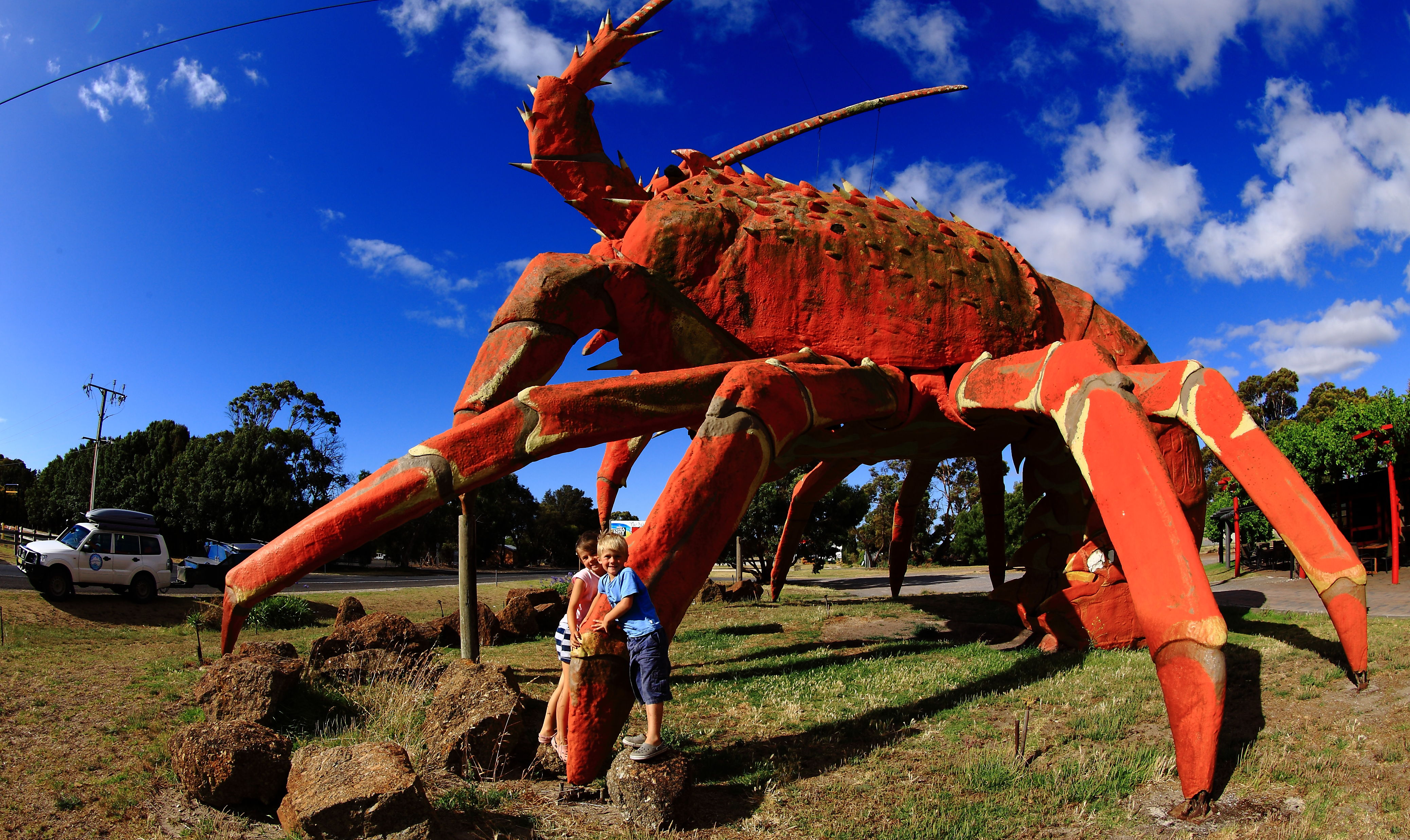
Then back to the coast, along small roads, watching emus running through the fields as we went, to see a big icon. The Kingston Big Lobster is an impressive construction, that we spotted from some distance out of town, lurching above the treeline.

The Big Lobster

The Big Lobster

It was late but we were keen to stop in the Coorong and we pressed on up the coast arriving much later than normal at 42 Mile Crossing. After a late dinner, the kids went to bed as dusk fell and I noticed we had a visitor. I set the camera up to catch him, came oh so close and got within 2 metres of him, but my flash scared him off before the shutter went. Waking up the next morning 2 shoes were missing, courtesy of Fantastic Mr Fox! It couldn’t take a pair but nicked one of Oscars and one of Xaviers. If I hadn’t retrieved Hannah’s before I went to bed it could have been the set! We found some foxes earths around the campsite but no sign of the shoes.

Spot the problem here

Spot the problem here

Next day we headed north to explore the shores of Lake Alexandrina, where the river Murray meets the coast. The birdlife was fabulous and we spotted quite a new species for the twitching list. At Narrung we caught a ferry across one part of the lake to Point Malcolm, which hosts the only inland freshwater lighthouse in the Southern Hemisphere, that was used when log barges used to ply the waters.

Then things went pear-shaped and we ended up with a broken windscreen late on Sat afternoon. With a ferry to catch at midday on Monday it was starting to look like we might be driving around for the next two weeks with a broken windscreen!

Categories: 4WD, Adventure, Beach, Camper Trailer, Discover Australia, Explore Australia, Journey Narrative, Kids Travel, Offroad, South Australia, Travel, Travel Adventure | Tags: , , , , , , , , , | 5 Comments

Blog at WordPress.com.