Natural World

Usher Point, Cape York

This slideshow requires JavaScript.

With the Tip thoroughly explored we decided to take a 50+km track with Simon, Hilary and the girls to Usher Point. The road condition and distance is sufficient to deter all but the hardened traveller, and from the Hema guide the track was going to be tough. We had heard reports of 5-6 hours travelling time required with bush tracks so tight you would be relieved of paintwork along the way. Parks and wildlife don’t encourage trailers either but we were up for a challenge, the first, and by far the hardest, booking one of the four campsites. Once again we wrestled with a ridiculous booking system, being told only one site was available by a second operator.

The drive out was actually nothing like what we expected. It took two hours and the road must have been cleared in recent years judging by the size of the track and regrowth rates. No paint scratching on this track and very few challenges other than a couple of sections of soft sand. The Camprite trailer cruised through as it has done for the last 11 months without a hiccup.
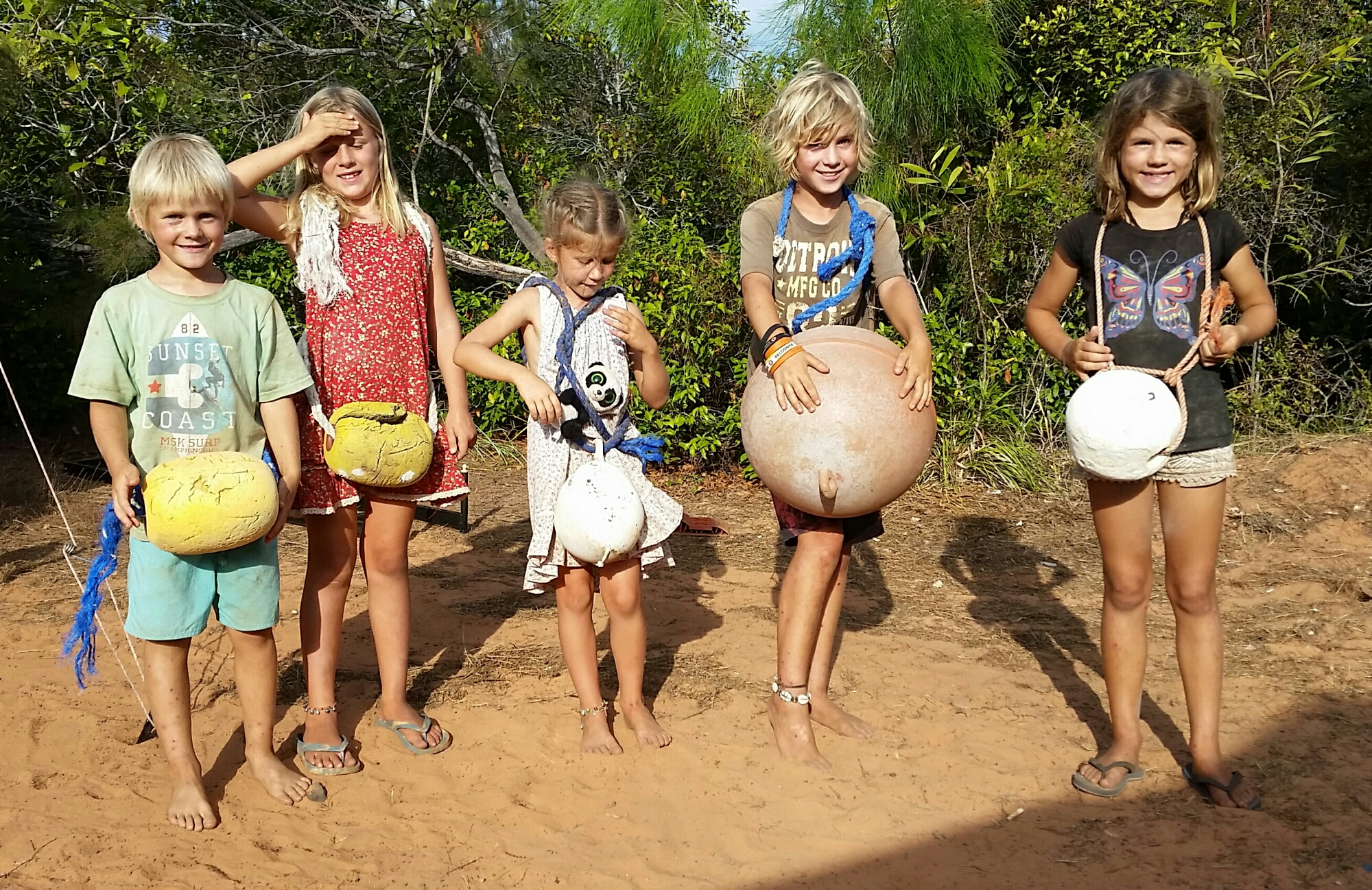
Camp fun with beach flotsam

Camp fun with beach flotsam

Our campground greeted us piled with flotsam and jetsam salvaged from the beach, a blessing in disguise as whilst unsightly it did provide hours of entertainment for the kids. The coastline was rugged and exposed to the strong onshore winds. The four campsites are spaced across 2+km of track, one in the rainforest, one in deep soft sand behind the beach, another perched precipitously on a totally unsheltered overhung cliff (not good for sleepwalkers), and ours, nestled in low-lying bush, very slightly sheltered.

A lot of beach combing yielded more chambered nautilus shells, and a surprising source of multi-coloured clay that the kids insisted on bringing back to camp to play with. Much of the cliff was clay, however large islands protruded from the sand in places, with thin layers of many colours.

Go-karts made from beach rubbish
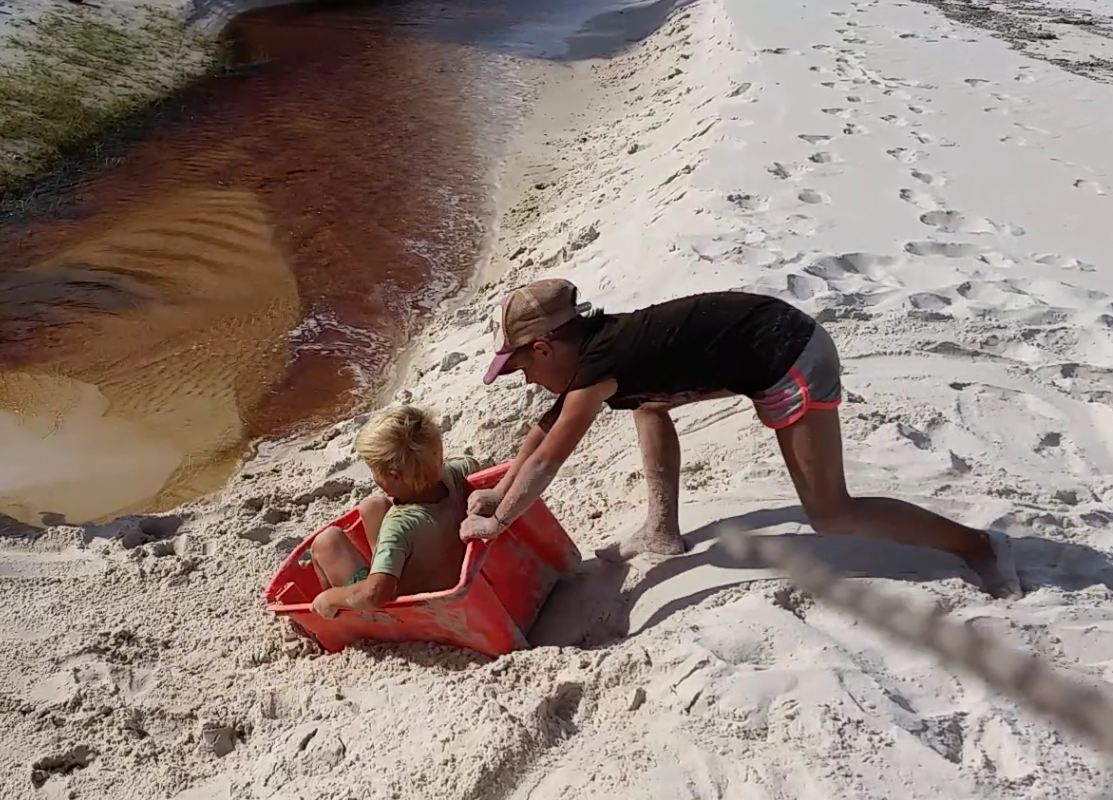
Go-karts made from beach rubbish

Gunshot Creek re-enactment

Gunshot Creek re-enactment

The kids used their imagination with items of rubbish found on the beach and from home-made go-karts made from fishing floats, raced down the track, to re-enactments of the Gunshot Creek crossing on the Old Telegraph Track, a lot of fun was had by all.
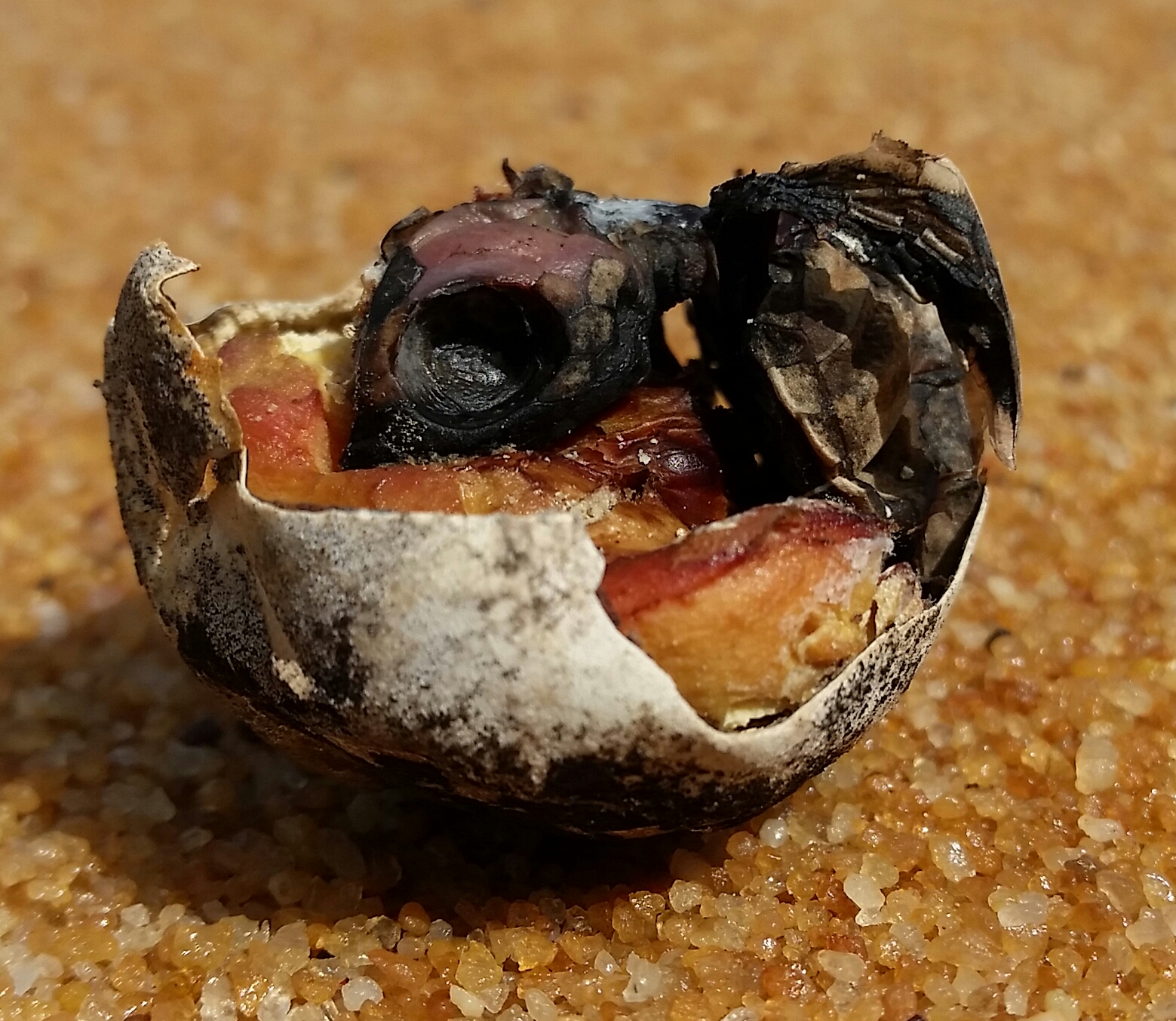
Turtle embryo in shell

Turtle embryo in shell

A broken turtle shell washed up one day with a dead embryo with features fully formed and clearly visible, including yolk.

The drive from the camp to the beach was the biggest challenge requiring lowering tyre pressures to handle the soft sand track and campsite. This sandy camp was separated by a murky but shallow creek, but fresh tracks indicated that it was inhabited by a small crocodile.
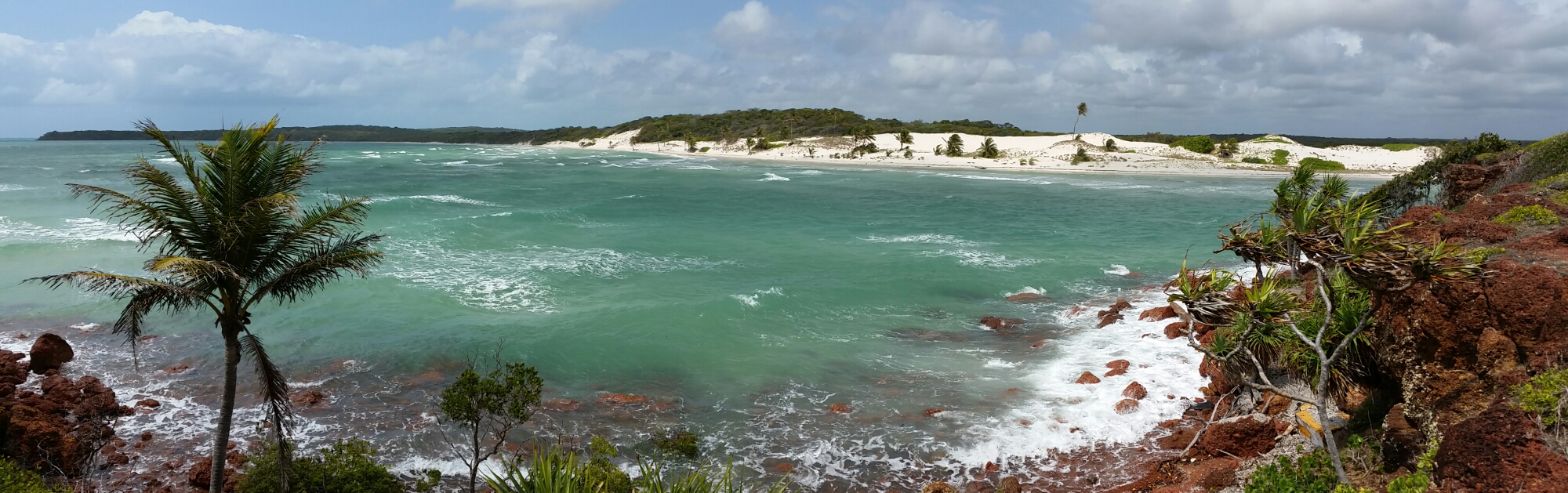
Sadd Point panorama

Sadd Point panorama

We stayed for three days, exploring the beaches, driving to Sadd Point nearby, and pushing an extremely scratchy track towards Escape Creek, where at times we were pushing over saplings higher than the car that were growing in there middle of the track.

The road to Sadd Point

The road to Sadd Point

I found a new favourite bird, the aptly named Magnificent Riflebird. Having heard its call I managed to coax one in close to see its beautiful metallic green collar, and hear its rustling feathers as it chased a female through the treetops. It eluded my attempts to photograph though.

This slideshow requires JavaScript.

Around the campfire on the first night we were interrupted by the erratic flight of a nightjar fluttering past several times. Following the frog-like sounds I found two sitting on the track every night. A Woompoo fruit dove allowed a close photo too one evening and once Simon’s very successful coconut lemon cake, cooked in the camp oven, wafted into the air we got regular visits from the local bandicoot.

Despite insistences from the booking consultant that campsites were full we saw no-one for three days at Usher Point. As we drove out a fallen tree across the road might have explained why, but four adults could move it aside quite easily, before we needed to reach for winches or saws.

Categories: 4WD, Adventure, australia, Australian Outback, Big Lap, Camper Trailer, Discover Australia, Explore Australia, Journey Narrative, Kids Travel, Natural World, Offroad, Photography, Queensland, Road trip, Travel, Travel Adventure, Wildlife | Tags: , , , , , , , , , | 2 Comments

Cape York, the Tip (Part 2)

With the northern most compass point of the mainland behind us there was still plenty to do. We explored a 4WD track from the tip that crossed to Punsand Bay. A fairly tight and rugged track but not too difficult. The old telegraph terminated at a concrete bunker located just behind Cable Beach. Further on little side tracks around Roonba point took us to isolated beaches and mangrove forests, where corkscrew palms  spiralled their way towards the sky. Amanda stopped to investigate orchids growing amongst the tree branches, a few flowers starting to show.

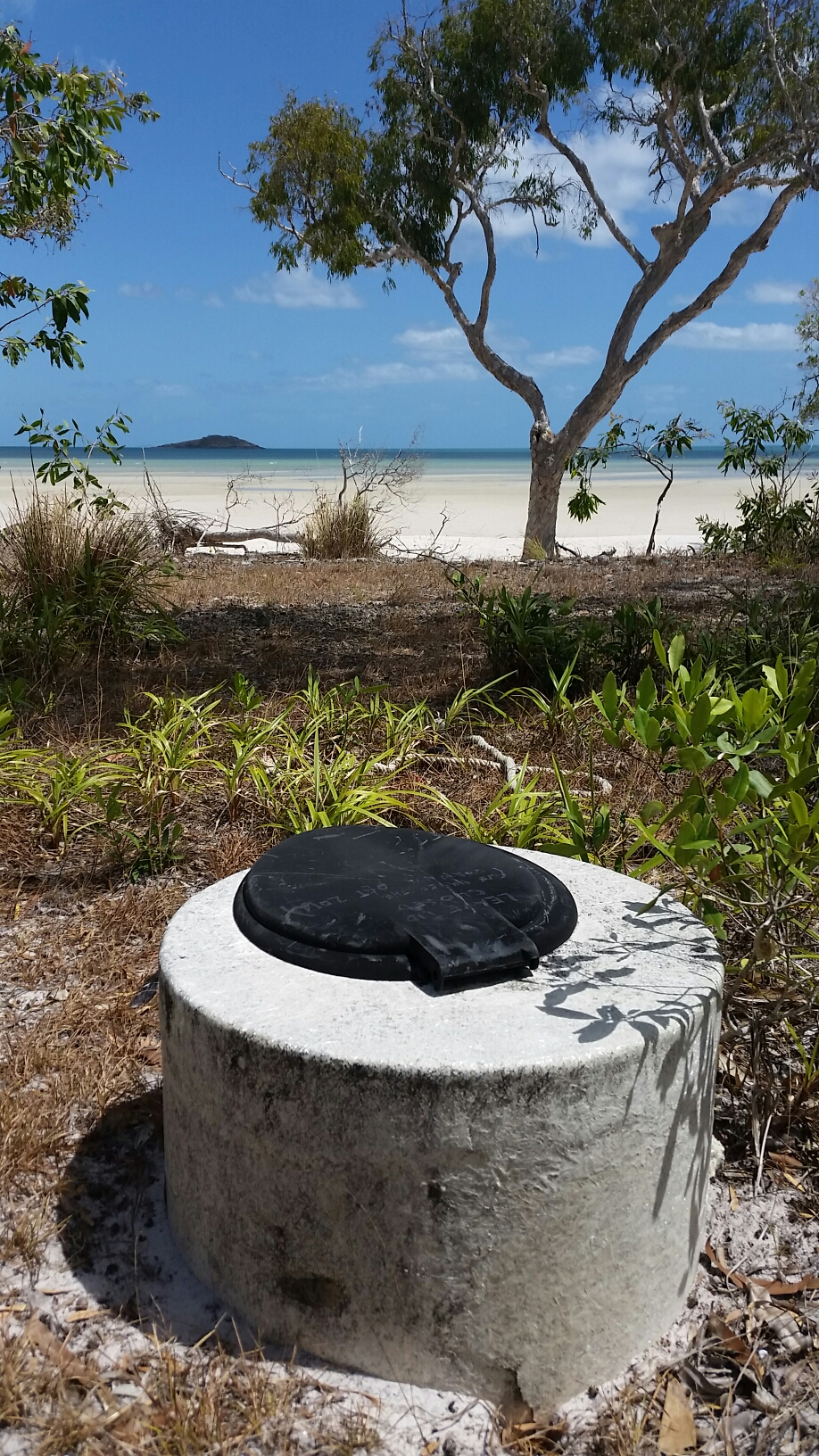
Loo with a view

Loo with a view

One track led along a beach offering camp opportunities all over the place. We even stumbled, almost literally over what was arguably the best “Loo with a view”, a concrete construction, seat but no surrounding privacy. Just sit down and enjoy the view.

There are also a few historical remnants from WW2 in the area and to explore these we moved to Alau Beach as a new base to explore. Firstly we visited two plane wrecks, a DC3 bomber and a Bristol Beaufort, both having sufficient remnants to make them out. There are references to 3 other wrecks but without further information we couldn’t seek them. We drove down to Jacky Jacky creek on a increasing derelict track to a local camp that must be used for collecting mud crabs and mud clams amongst the mangroves.

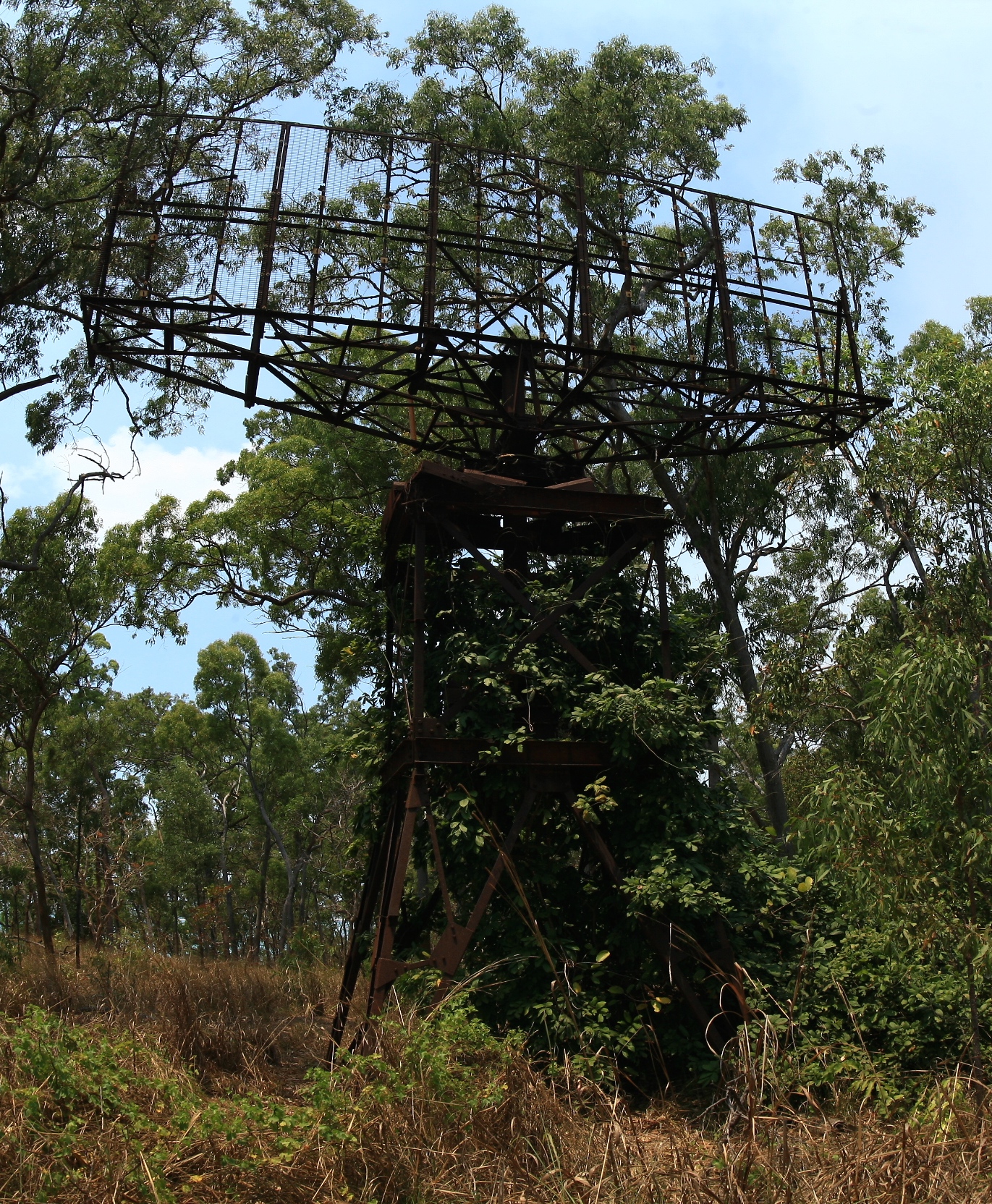
Muttee Head WW2 radar tower

Muttee Head WW2 radar tower

Another road took us out to Muttee Head, and beyond to the mouth of the Jardine River. An old derelict and severely rusting radar tower stands forlornly in the forest, covered in vines, a stark reminder of the proximity of this part of Australia to action in the war.

Around the sleepy towns of Seisia and Bamaga it was impossible to miss the large numbers of horses wandering around untethered. Roaming along the roadsides, grazing through peoples gardens, some of them looking in very fine condition. Every now and then youngsters would trot past on their unsaddled steeds, all very adept in the art of horsemanship no matter what age.

We moved to Alau beach for a few days and Oscar and I took time out to fish from Seisia Jetty, once the weekly barge had been unloaded, reloaded, and departed. A large group of locals played in the water next to the jetty and a group of youngsters brought their horses for a swim to cool off in the searing heat of the midday sun.

The teenagers led their horses into the water, then stood on their backs and performed backflips into the water, in an effort to entertain the younger boys watching. Once cooled off they mounted the horses and cantered up the beach and back to the crowd swimming and frolicking behind us.

I felt a large tug on my line then suddenly the water surface erupted with a pirouetting shark, over 2m long. It performed this action 3 times, its entire body clearing the water each time, as it stripped line off my reel, then thankfully snapped it. A laconic comment from an elderly local fishing nearby suggested this was why no-one was catching anything. Another fishermen barked a call in local tongue to the crowd in the water and a mass exit, that any lifesaver would have been proud of, took place in seconds. Apparently crocodiles are not scary but big sharks are!

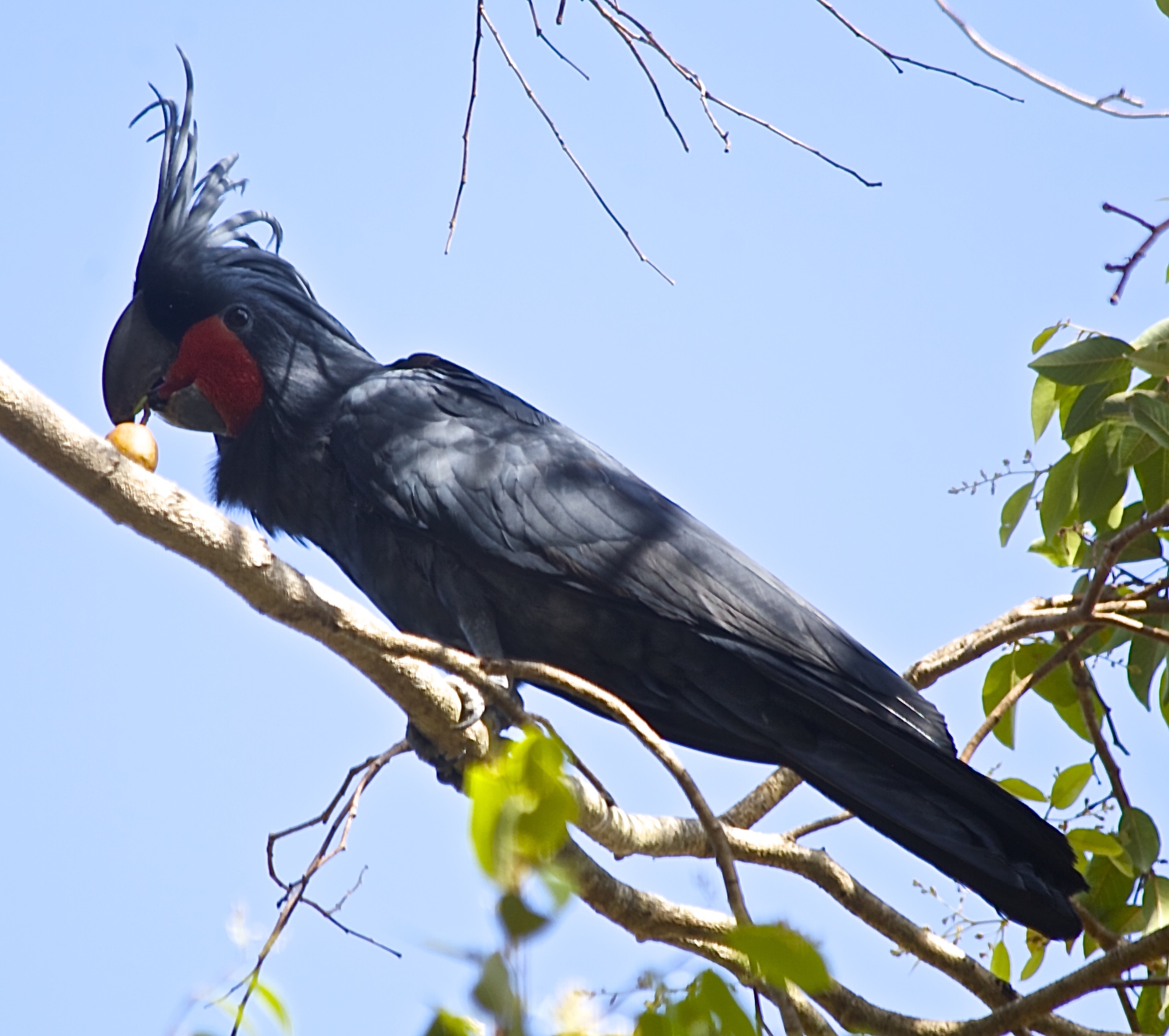
Palm Cockatoo

Palm Cockatoo

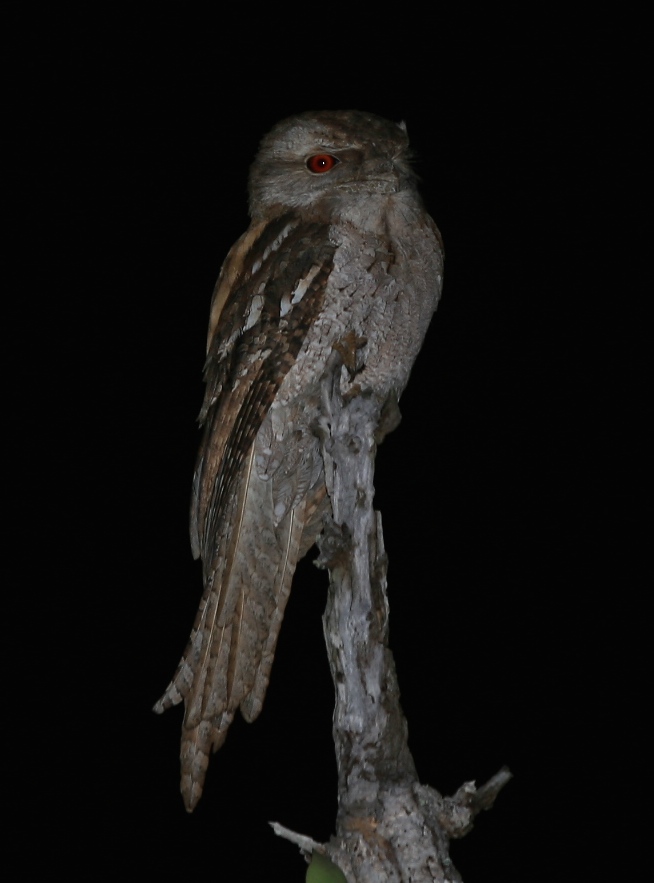
Frogmouth

Frogmouth

Back at our beach camp in Alau, the local trees acted as magnets for the birds and we were treated to Palm Cockatoos, yellow bellied sunbirds, frogmouths, kingfishers and many more.


Categories: 4WD, Adventure, australia, Australian Outback, Beach, Discover Australia, Explore Australia, Journey Narrative, Kids Travel, Natural World, Offroad, Photos, Queensland, Travel, Travel Adventure | Tags: , , , , , | 3 Comments

Cape York, The Tip (Part 1)

Firstly thanks to all the responses helping with my computer. It probably won’t be fixed until we get home which means blogging will be less frequent and probably fewer photos for a while.

After decamping from the beautifully tranquil Jardine River a short but very corrugated drive brought us to the ferry crossing where the 20m crossing costs you $129 and lasts barely a couple of minutes. It sounds expensive but is a return fare and does include the permit to enter the indigenous area as well as camping in designated areas around the tip of Cape York.

Bamaga is a sleepy township in the far north, offering a decent sized supermarket, post office, tavern, bakery and general store amongst others. A hasty re-fuel and restock and we headed 35km to the north easterly point of the Cape, to a campsite called Somerset. The Somerset Homestead is now in ruins, established in 1863 by John Jardine, farmed cattle, copra and had other commercial interests that included involvement in the pearling industry. Near to the campsite there are some old cannons, gravesites and some derelict ruins providing the inquisitive with a glimpse into the hardships of the past here. Fragments of old hand-blown black glass bottles can be found scattered in the bush, many dating back to the late 19th century.

Along the shoreline, behind the mangroves you can also find the remains of an old freshwater spring that was pooled as salvation for shipwrecked sailors, and graves of Japanese pearl divers.

Also along the shoreline, after negotiating crocodile infested mangroves and climbing the sharp rocks some remarkable indigenous art can be found in a cave, considerably pre-dating the homestead. Figures of fish, crocodiles and turtles, as well as other unidentifiable shapes were all clearly visible.

Some 900m away the large island of Albany offers fishing charter holidays, but has untouched beaches covered in turtle tracks with crystal clear water. The island also offered some protection from the prevailing onshore winds that greeted us all the way up the east coast of the Cape.

We explored the neighbouring coastline taking the five beaches track that weaves southwards through the bushland between beaches. We met another family with kids at SDEPS (whom we hadn’t seen for months) and took the photo at Fly Point of all the 8 kids. At the end of the track we found tracks that kept going and we explored at least two more beaches, the kids finding plenty of their new favourite shell, the chambered nautilus. Surprisingly there was less rubbish on the beaches here, probably because of the protection from Albany island.

Yellow-bellied sunbird

Yellow-bellied sunbird

The abundant and unique birdlife at the tip of the Cape York also provided an interesting diversion at dawn whilst everyone else was still waking up. The tally is now fast approaching 300 species on the trip and favourite birds have been changing regularly. Here the yellow-bellied sunbird was a welcome treat around the trailer.

This slideshow requires JavaScript.

The next day we had a challenge to meet, the third compass extremity of the mainland, Australia’s most northerly point. The dirt road wasn’t too bad, weaving at times through lush rainforest, before opening up at the beach. A short walk over the craggy headland past enormous rock cairns brought us to a very unimpressive simple sign at the northerly tip. Three down one to go!

Categories: 4WD, Adventure, australia, Australian Outback, Beach, Big Lap, Journey Narrative, Natural World, Photos, QLD, Queensland, Road trip, Travel, Travel Adventure, Wildlife | Tags: , , , , | 4 Comments

The Old Telegraph Track, Cape York (Part 3)

Following the fun at Gunshot Creek watching others trying to avoid breaking their cars it was time for us to have some fun as we headed to Fruit Bat Falls and Eliot Falls. Less than 30km north we turned off to Fruit Bat Falls for an early morning swim before the crowds arrived. The river is fairly shallow running over a rock platform then drops a couple of metres per the falls into a sandy pool below, great fun for swimming with the kids.

This slideshow requires JavaScript.

Sufficiently cooled off we decide to head to the camp at Eliot Falls for lunch. 12km away we had heard the road had a particularly deep crossing, marked innocently as a ford. Scrubby Creek as it is known was silted up on arrival so we had to wade it, water levels reaching the thigh, deeper in the middle. After watching cars go through on both sides we crossed without trauma, sticking to the one side. The park itself sits on the edge of the Jardine River National Park and Heathlands Regional Park. At Eliot there are three main waterholes called the Saucepan, Twin and Eliot falls. The former was a deep section of the Eliot river with cascades into it, allowing older kids to jump from the sides. Twin Falls was more picturesque with a series of small waterfalls into sandy bottomed shallow pools, fed from Canal Creek and more suitable for younger children. The clarity of the water proved popular with our kids as they fossicked for stones in the river bed. Pitcher plants, sundews and bladderworts, all insectivorous plants lined the riverbanks, testament to the nutrient poor soil on and around the limestone rock.

Eliot Falls themselves were the biggest falls offering 3m jumps into the middle of the horseshoe shaped falls. Below the falls deep rocky sections flowed rapidly over large boulders offering lap pool alternatives, swimming into the current. Where the two rivers meet it was noticeably warmer water coming from Canal Creek.

We spent two days here relaxing with plenty of swimming to cool us from the searing heat. For such a popular spot it was a shame to have no visible Park Ranger presence whilst we were there. People had dogs in the park, generators on at night, people ripping down trees in the campground for firewood, and Simon and Hilary even spotted people soaping up ready to wash in the rivers. It won’t be long before it becomes a lot less attractive if Queensland Parks don’t raise their game, focus on the site preservation rather than the ridiculous online camping booking system aimed at revenue raising rather than customer experience. The city-dwelling consultants who sold that one to the government should be ashamed of themselves as they clearly don’t understand how travellers operate. Maybe another blog for that one!


Categories: 4WD, Adventure, australia, Australian Outback, Big Lap, Discover Australia, Explore Australia, Journey Narrative, Kids Travel, National Park, Natural World, Offroad, Photography, Queensland, Road trip, Travel, Travel Adventure | Tags: , , , , , , | Leave a comment

Boudjamulla National Park (Lawn Hill)

Riversleigh is a world heritage site based on the abundance of unique fossil deposits found there. To get there we had a relatively short drive from our camp at the O’Shaughnessy River, two short, shallow, but surprisingly slippery river crossings, and the obligatory corrugated rocky dirt road that makes the outback what it is. Whilst it appears to be an unremarkable spot on the surface, the signs provided allow visitors to look past the dusty, dry rocky landscape. For even the more imaginative visitor visualisation of the change in landscape over millions of years is challenging as the fossil record represents eras of marine reef, through to swamps when giant 4m freshwater crocodiles were the apex predators, and then elephant birds whose enormous size meant they couldn’t fly.

One fossil in the rock exposed a cross section of a turtle shell thought to be long extinct, however, as recently as 1995 the gulf snapping turtle was rediscovered in the Lawn Hill river system, thriving as it has done for thousands if not millions of years without change.

A short drive from this hot arid, fly-ridden place brought us to the oasis that is Boudjamulla National Park. The deep gorge and pandanus-lined river is a verdant oasis for fish and birdlife. Water levels were low and the Cascades had no water flowing over them, however the Indarri Falls, less than a kilometre upstream, spilled beautiful green, warm, lime-saturated water into the gorge. The water turbulence at the falls causes a gaseous release of carbon dioxide and the “tufa”, as it is called, is deposited at a surprising rapid rate, 2-3cm annually. The falls are not large, less than 3m in height, and covered in pandanus growth. Below the falls barramundi and turtles abound and we all spent hours exploring every nook and cranny.

The park also offers a number of bushwalks. The Wild Dog Dreaming track leads you along the river bank to a cliff face covered in ancient petroglyph art and more recent Waanyi rainbow serpent artwork. Island Stacks offered a walk on the limestone escarpment above the gorge, but the longest walk up the gorge was closed due to the threat of a grumpy buffalo that had recently been spotted up there.

All the forests were busy with birds and we spotted a pair of large channel-billed cuckoos near the trailer, and a whistling kite’s continual call gave away it’s nest site above the river, high in the outreaching limbs of a Eucalypt tree.

Canoes could be hired to explore but there was no need, and one day we made the decision to swim the one plus kilometre back to camp through the gorge, while Amanda carried our clothes back. The kids jumped on their inner tubes (presents from our friends at Marree Hotel so long ago now) and conquered the journey in no time at all.


Categories: Adventure, australia, Australian Outback, Big Lap, Camper Trailer, Discover Australia, Explore Australia, Journey Narrative, Kids Travel, National Park, Natural World, Photography, Photos, QLD, Road trip, Travel, Travel Adventure, Walks, Wildlife | Tags: , , , | 4 Comments

Uluru-Kata Tjuta National Park (Ayers Rock & The Olgas)

Speeding towards Uluru National Park the next morning we past the “Grismacks” heading in the opposite direction, the last time we will see them on this trip as we head in different directions.

Uluru, also know as Ayers Rock, is a massive monolith (single rock) made of sandstone, that erupts from the flat surrounding landscape, famous for its changing colours as the sun sets in the evenings. It is over 400km from Alice Springs and many people, including a couple in our car, mistake their first glimpse of Mt Connor for Uluru. They are actually very different, Mt Connor having a flat top and precipitous walls surrounding it, whilst Uluru is much more rounded in appearance.

We had decided to try and climb Uluru and given that it had been windy and closed for climbing in recent days, had crossed all fingers and toes, hoping for a calm day. With the wind definitely increasing as we arrived we filled up our water and headed through the gate. The first section is the steepest as you follow the chains up the side of the monolith. Within 100m Xavier made a sensible decision, given his fear of heights, and decided not to proceed. Shortly after, Hannah muttered something and turned around too. Down to three of us left, Amanda, Oscar (with his visiting school toy, Wilma wombat) and myself we trudged up the calf-punishing rock. We even passed one clown walking in thongs, who lost one over the edge when he finally turned around.

Oscar was in fine form and paced onward and upward. Amanda fell back. At the top of the chain an interrupted white line guides you across the undulating top of the rock and after a few short climbs Oscar and I celebrated at the peak with a high five, then photo opportunities with Wilma. We waited for Amanda, waited some more, then with an increasing wind threatening to make the descent interesting we decided to return.

Whilst it might be somewhat controversial to climb the rock, the ceremonial sacred sites are actually around the base of the rock, and the local Anangu people’s main concern is that people don’t harm themselves on the rock (over 35 people have died trying to climb it). Having enjoyed walking the 10km walk around the base previously I justified the climb based on the fact I was not disrespecting ceremonial sacred sites.

Watching the sunset on the rock with the kids proved a little disappointing as cloud cover restricted sunlight hitting the rock.

Next day I was struck with illness so the others headed off to Kaja Tjuta (The Olgas), and the highlight of their trip proved to be the camel farm that they dropped into for a photograph session with Wilma the Wombat. After generously facilitating the photos the girl at the farm let them prepare saddles for the sunset ride, and even gave them all a quick free ride around the yard on the camels. Two hours were spent at the camel farm and only 30 minutes at the Olgas!

That evening our plans changed dramatically and instead of heading south towards Coober Pedy again we chose to back-track north, to take the Plenty Highway to enter Queensland rather than the more arduous plan across a number of desert tracks to Dalhousie, Birdsville, all of which will have to wait for next time.

Categories: Adventure, australia, Australian Outback, Big Lap, Discover Australia, Explore Australia, Journey Narrative, Kids Travel, National Park, Natural World, Northern Territory, Photos, Road trip, Travel, Travel Adventure, Walks | Tags: , , , | 2 Comments

Watarrka National Park (Kings Canyon)

Clutching our permits that allowed us access to the Mereenie Loop we left Palm Valley early choosing to take the shorter route to Watarrka National Park. Travel early in the day is recommended to avoid afternoon sun in your eyes heading west. The unsealed road was rough, but fine to drive and nothing like a few of the 4WD tracks in the area. It passed through typical central Australian landscape of grassy savannah, sparsely populated with the Casuarina or sheoak trees, and the red dusty dirt that prevails everywhere.

It was a hot day and we decided to walk the 5km loop around Kings Canyon, rather than the short trip up the valley. The start was a punishing steep climb up a rock staircase, in searing heat, but once conquered the rest of the walk was pretty comfortable and relatively flat. At various points the unrestrained lookouts give you an eagle’s eye view of the canyon, sheer, flat, often overhung cliff faces disappearing into the treetops below. As soon they put up barricades for people’s safety (or protection from their stupidity) the raw beauty will be lost, but until then it remains a truly unspoilt natural wonder. Unfortunately though, Xavier doesn’t have a head for heights so he is noticeably absent from the photos as we couldn’t coax him to join us.

Around the halfway mark the track allows you to enter the “Garden of Eden”, an oasis below the cliffs that has abundant cycad growth and at the base an icy cold pool provides refreshing relief to the overheating walker. Four of us took what must be one of the shortest “dips” we have had and as the cold took hold it was hilarious to see everyone’s faces change to horror, then the mad scramble to scale the slippery rock-face back into the warm sunlight.

Beyond this there is a section of the walk that resembles the Bungle Bungles, a vista of layered beehive-shaped rocks covering the top of that part of the canyon.

With insufficient energy left to attempt another walk in the 33 degree heat we found an early camp secreted away in the bush, made a campfire and settled in to enjoy an undisturbed evening below a magnificent escarpment near Kings Creek. It was in the fading sunlight that Amanda noticed we had a flat tyre and I was obliged to perform a hasty change lying in the rocks and dirt before the light disappeared.


Categories: Adventure, australia, Australian Outback, Big Lap, Discover Australia, Explore Australia, Journey Narrative, Kids Travel, National Park, Natural World, Northern Territory, NT, Offroad, Photography, Photos, Travel, Travel Adventure | Tags: , , | 2 Comments

West from Alice Springs

Our first night in Alice saw temperatures plummet to 3 degrees. What few warm clothes we had came out but it was actually quite nice as by 9am the temperature had risen enough to be comfortable again. With all warm clothes stowed again we headed out of town along the West MacDonnell Ranges.

Knowing it was a short drive for the day we made some impromptu unplanned stops as we went. First up was Simpsons Gap in the Tjoritja / West. MacDonnell National Park. Following the dry river bed towards the gap I was surprised to see “No Swimming” signs but at the gap there was a substantial lake full of icy cold water. A few black-footed wallabies hopped around the rock piles on both sides of the gap, looking down intently watching our every move. We also spotted plenty of striated grass wren jumping around the rocks and grass.

A little further along the road we stopped to have a look at the local indigenous artist, Kathleen Buzzacott’s studio. Everyone loved the deep bowls filled with coloured seeds, and running hands through them just felt so good! The kids were interested in the jewellery made from the seeds and then watched intently as Kathleen showed them how to dot-paint. A very interesting stop that inspired the kids drawing efforts that afternoon in the car.

Hermannsberg was established as a Lutherian Mission in 1877 by two newly arrived missionaries from Germany. Their trip alone to the area was a marathon of hardships and drought, having being despatched in mid-summer. Today the mission offers an insight to outback life in the late 19th century. The kids marvelled at the size of the porridge pot, particularly as we all ate hot porridge for breakfast. We also learnt that in the indigenous language, Arrernte, there are only four number words, for 1,2,3 then everything beyond this is “a mob”. The kids struggled  trying to grasp the concept, but an apple strudel was beckoning us in the café so we moved out of the school.

Just on the other side of Hermannsberg a dirt and sandy road led us up to Palm Valley. Having grabbed a campsite we decided to visit the valley before sunset and set off up a very rocky 4WD track to the start of the walk. It was slow and bumpy and the sun was falling fast but we all managed to make the 5km loop walk , then negotiate the track back down before nightfall. The deep-rich red colours of the valley rock walls were amazing to see as the sun dropped further in the sky, and to see Cabbage Tree palms nestled in the valley was interesting as the 2,000 odd palms are an isolated population, their nearest relatives being over 800km away in Queensland.

Categories: 4WD, australia, Australian Outback, Big Lap, Camper Trailer, Discover Australia, Explore Australia, Journey Narrative, Kids Travel, National Park, Natural World, Northern Territory, Offroad, Photos, Road trip, Travel, Travel Adventure, Walks | Tags: , , , , | Leave a comment

Devils Marbles (Karlu Karlu)

It is a long drive from Mataranka to Alice Springs, with not much in between, and the major town, Tennant Creek, by all accounts is not worth staying in. We chose to ease ourselves into the cooler climate gently with two stops before Alice Springs. The first day we made a stop in Daly Waters to see the Stuart’s Tree, basically a tree stump with a large “S” engraved in the trunk (clearly visible if you squint both eyes and turn your neck at 45 degrees), supposedly engraved by John McDouall Stuart’s party on his third attempt to reach Darwin from the south in 1861/2. Then we had a quick look at the Daly Waters pub. Every inch of the walls and ceiling is adorned with caps, police badges, bras, foreign currency notes, rugby shorts, and much more. A cold beer would have been welcome but we still had more driving to do.

This slideshow requires JavaScript.

Very close to the town of Elliot, we stopped for the night at a magnificent birding spot known as Longreach billabong. This long waterhole allowed waterfront camping and as we sat there stately jabiru storks, spoonbills, and brolgas strutted along the water’s edge. Meanwhile, darters sunned themselves with wings outspread, and rainbow bee-eaters scanned the sky for their next meal while sitting on dead branches.

The sunset was one of the best we have seen on the trip and our fellow travellers from home, Joel and Abelia “Our Roaming Home” finally caught up with us to exchange stories around a campfire. A great finish to the day.

Up early the next day, after a chilly night, we set off for Kunjarra (The Pebbles) a sacred women’s site just north of Tennant Creek. The site itself offered little more than a chance to stretch our legs and stroll along a short path through a hillside of small rocks, so we didn’t stop long.

Just beyond Tennant Creek is another hillside covered in rocks, but Karlu Karlu, or the Devils Marbles are more impressive and worthy of a stopover. The campsite was very popular (full) but we squeezed in a spot and set off to explore before the sun went down. We all had a lot of fun exploring the rocks, climbing all over them, and Xavier read us the Dreaming stories of the Devil Man, Arrange who spat on the ground, where it turned into the granite boulders that now litter the surrounding landscape. Plenty of photo opportunities kept me busy, even early the next morning before we left.

Categories: Adventure, Animal Action, australia, Australian Outback, Big Lap, Camper Trailer, Discover Australia, Explore Australia, Journey Narrative, Kids Travel, Natural World, Photography, Photos, Road trip, Travel, Travel Adventure, Wildlife | Tags: , , , , , , , , , , , , | 1 Comment

Bitter Springs(Mataranka)

It was nice to get back on the bitumen road again. The prospect of soaking in crystal clear hot springs after 700km of dirt road from Arnhemland was the major appeal drawing us to the tiny village of Mataranka. There is an odd hobby of the locals to dress termite mounds with T-shirts, rugby shorts, dresses, in fact quite a lot of different costumes. We saw a great selection from Santas to wedding dresses as we drove along but none of it was actually more visually appealing than the sight of the original unadorned version.

Mataranka was where the film “We of the Never Never” was filmed, a story about a Melbourne born upper class woman adjusting to life in the outback, set in 1902. Arriving in the village many half size characters, presumably from the movie, are scattered on the communal area opposite the shops and roadhouses. Half way down the main road a giant termite mound is signposted, though difficult to miss as it sits almost on the roadside.

This slideshow requires JavaScript.

We settled into a pleasant campsite nearby in Elsey National Park, next to the Roper River, famous (apparently) for Barramundi, though we caught nothing once more. On the 8km walk to nearby Mataranka Falls we noticed a crocodile trap, and then saw one just below the falls, so despite the clear waters once again it was a no swimming zone. Apparently there are normally swimming pontoons in the river but their absence was replaced with crocodile traps. The falls themselves were a little disappointing being a metre drop over a rock platform, but the walk along the pandanus-lined river bank was pleasant enough. The National Park appears to have large pests infesting the forest and I wasn’t expected to be kept up each night by wildly braying donkeys. Quite amusing in the location and far more preferable than having caravans on your doorstep as was the case in the parks near Bitter Springs. There was also evidence of feral pigs along the river.

Bitter Springs is a constant 30-32 degrees of sulphurous, gin clear water, that seeps from a deep aquifer and slowly meanders through a forest. People arrive in droves to sit on floating “noodles” and drift slowly down. Once or twice is probably enough but the kids insisted we revisited three days on the trot and spent quite a few hours there exploring every nook and cranny up and down stream. We found turtles and fish, and dived under the logs until all toes and digits went totally wrinkled in the warm water.

After some peace and tranquillity for three days with minimal driving it was time to start thinking about heading south into cooler climes, to collect school work from Alice Springs.

Categories: Adventure, australia, Australian Outback, Big Lap, Camper Trailer, Discover Australia, Explore Australia, Journey Narrative, Kids Travel, National Park, Natural World, Northern Territory, Photography, Photos, Road trip, Travel, Travel Adventure | Tags: , , , | 3 Comments

Create a free website or blog at WordPress.com.