Natural World

East Arnhemland (Part 4 – Cape Arnhem)

This slideshow requires JavaScript.

A special permit is required to enter Cape Arnhem, over and above the transit permit required to travel there. Only 10 vehicles are permitted at a time with no trailers, width, height and weight restrictions also exist due to some of the tracks passing through low hanging bush, between trees or over soft sand. This meant having to abandon our beloved home, the Camprite trailer, and pull the emergency tents from the roof pod. We even bought an esky for the trip to keep our food cold.

The trailer was parked at Chris and Emi’s house in Nhulunbuy and Amanda was excited at their kind offer to do a clothes wash for us while away.

Entrance to the Cape was via a rugged dirt road along an escarpment with glimpses through the forest of beach and mangroves below. A lookout several kilometres in is where the fun starts. Having taken in the views up and down the coastline the road drops steeply down the escarpment into the forest below, weaves through narrow gaps between tall trees before becoming sandy. Taking no chances I dropped tyre pressures below the recommended 20 PSI and pressed on. Without a map there were a surprising number of trails leading off, though most of them return to meet, and without too much difficulty we headed in the right direction. There are over 50 sacred sites on the Cape, the main one known as Twin Eagles, where visitors may drive by but not stop to picnic, camp or fish. The drive north up the Cape involves beach and dune work, sometimes particularly soft and there was plenty of evidence of “boggings” along the way.

The sandy beaches looked attractive on approach but our hearts sank somewhat at the volume of sea-borne debris and detritus that littered most of them. Then sadness turned to dismay when we spotted a bottlenose dolphin washed up on the beach. We pulled over and dashed to see if we could save it but it looked like it had only recently died. Not knowing what had killed it (no obvious visible cause) we paused and walked down the beach collecting thongs (flip flops for those reading in the UK) that covered the sand. Over one hundred were recovered and placed on the car roof. Most of the debris has been brought from Asia by prevailing winds and ocean currents, or dumped from ships passing.

We found a campsite known as the Penthouse, at the furthest point north that visitors are allowed, set up camp and then found a dead turtle on the beach below. Some rangers had obviously stayed prior and had enjoyed a feast of mud mussels and turtle eggs, judging by the discarded remnants on the edge of the camp.

A small crocodile swam in to shelter behind the reef as the rough ocean was still being stirred up by strong easterly winds.

The hammock was brought out and we switched into relaxed desert island chilling mode. The kids explored, we fished (Oscar was happy to catch a queenfish) and Amanda sat in the hammock reading.

The next day we wanted to make a further impact and we chose the same beaches, this time targeting cigarette lighters. Over 300 were retrieved and disposed of. The children were somewhat distracted by their search for Chambered Nautilus shells that they had started to find but all helped fill the bucket. We noticed the difference but we couldn’t collect all the ghost nets, toothbrushes, light bulbs, and a plethora of miscellaneous glass and plastic bottles, jars and other items. And all the time the winds were bringing in new items. We found two more dead turtles too on the beaches. Others had obviously tried before us and had left the debris in a tree. We chose to dispose of it.

On returning to camp Xavier found a fossilised chambered nautilus in rocks nearby making us all ponder how long these animals have been around, long before humans polluted these beaches.

The sandy tracks allow a couple of days exploring. To the south there is another camp near caves beach and whilst folk do swim the crocodiles are there as we saw so extreme precaution is recommended if entering the water.

Despite the rubbish on the beaches this is a great place to escape and experience the beauty of Arnhemland.

Categories: 4WD, Adventure, australia, Australian Outback, Beach, Big Lap, Camper Trailer, Car, Discover Australia, Explore Australia, Fishing, Journey Narrative, Kids Travel, Mitsubishi, Natural World, Northern Territory, Offroad, Photography, Photos, Road trip, Travel, Travel Adventure, Wildlife | Tags: , , , , , , | Leave a comment

East Arnhemland (Part 3 – Maccassan Beach)

From Giddy River we relocated to Maccassan Beach as a base to explore the surrounding area. One of our permits gave us access to the Dhimurru recreational areas to camp and this area includes a number of sites along the coast. Some 15km off the main, but unsealed road into Nhulunbuy, a signposted track leads you to a beach called Little Bondi. The track to the beach was tight and scratchy increasingly enclosed by bush on all sides as you approach, then soft white sand. I stopped short so we could check out the camp spot but despite the tranquil location it wasn’t deemed good enough for Fifty Toes Walkabout! Somewhat surprised by the decision we moved to turn around, but we had other beaches to check first. The only way out was to drive further onto the sand and we got bogged. With tyre pressures reduced even further and the recovery tracks in place we freed and after a nervous drive down the beach executed a hairy turn the soft sand, then back down to the hard stuff. Next stop Turtle Beach. This was a tiny beach with a couple of sheltered campsites. It looked great but no sun for our solar panels. The final spot was Maccassan beach, perfect for us with plenty of space, a few trees offering plenty of shade and plenty of open space and a bigger beach. The bauxite rock platform even promised fishing opportunities, but the onshore wind had built up and didn’t look like abating soon.

Nearby there was an interesting sacred site, unlike any other we had encountered to date. A fleet of up to 60 Maccassan trading boats from Sulawesi used to travel to this area on prevailing trade winds in December each year, for centuries up to 1907, to trade knives, tools and food for Trepang, or sea slugs. Each boat would carry up to 40 men and the 1,600km journey would take two weeks. The return leg would take place when the trade winds turned in April, often engaging local Yolngu people in the process.

The site consists of bauxite rock placements representing details of the trading interaction. Sections of the trading boats, called Praus line the ground in detail, others show the style of fireplaces required to boil the trepang, and fish traps.

Regulations imposed by a wary government in 1907 required these boats to register for tax in Darwin first, and trade winds couldn’t get them there so the trade ceased. The site consists of bauxite rock placements representing details of the trade. The rock placements are the only remnant of that ancient trade.

Bauxite is everywhere and for this reason Rio Tinto Alcan have a mine here. As a by-product of the mine’s presence in the Gove Peninsula Nhulunbuy is the sixth largest town in NT with a booming population of just under 4,000. Infrastructure is quite advanced for such a remote area and the hospital looked large for the town size.

The beach proved interesting, each day new tracks revealed nocturnal visits by crocodiles, turtles, and a few unknown creatures. Xavier and I walked to Turtle Beach past a billabong that was teeming with juvenile cane toads. You couldn’t help but tread on them with each step but too many to be able to do anything about them.

We took a drive to Rainbow Cliffs, then onto Goanna Lagoon. The road was comical because the original road runs direct into the bush but is crossed by tree trunk after trunk, brought down in recent cyclones, making the direct route impassable. Instead you have to zig zag your way constantly crossing the road at right angles to avoid the trees. Perseverance with the drive is rewarded with an opportunity to jump into crystal clear cooling waters (once you’ve checked for crocodiles of course) and the kids made the most of it.

We visited the exclusive art centre at Yirrkala where local artist’s work is showcased in an immaculate gallery. Whilst beyond our budget some of the artwork here was of particularly high quality, and the church panels in the museum gallery were a labour of love that took months to complete, depicting many of the cultural traditions. The Yolngu culture here is very strong and the people look so much more relaxed and comfortable, possibly because they have ownership of their own land and appear to be more in control of their destiny than in other areas we have seen. That said there are still many issues surrounding family, alcohol and drug abuse that one is constantly reminded of by posters around town, at the festival, and in local papers.

Then we explored the empty town beaches, starting at the refinery jetty where we watched dolphins and fished unsuccessfully again. Woodys beach was a hit, offering another safe swimming option in an enclosed but shallow area. A sandbar offered a walk to an island but with an incoming tide and a deep 4m wide channel to complete the crossing, we stopped. The next few beaches were deserted too and equally nice but we had a booking i.e. another permit to visit Cape Arnhem

Categories: 4WD, Adventure, australia, Australian Outback, Beach, Big Lap, Camper Trailer, Discover Australia, Explore Australia, Journey Narrative, Kids Travel, Natural World, Northern Territory, Offroad, Photos, Road trip, Travel, Travel Adventure | Tags: , , , , , , , , , | 1 Comment

East Arnhemland (Part 1 – The road to Nhulunbuy)

This slideshow requires JavaScript.

To travel into most of Arnhemland you need a travel permit, then to stay there you need another permit. Depending upon where you plan to visit you need other permits so a little preparation is required to enter this area. Permits are obtainable through the Northern Land Council and we got the most helpful lady you could wish for in the Katherine office. The first bombshell she dropped was “Are you going for the Garma festival?”. We pleaded ignorance and was informed it was the biggest indigenous event of the year, four days of celebrations, all sounding very exciting and just what we were after, however whe told us it had been sold out for months. The second bombshell was it was a public holiday in NT and she enquired whether we had accommodation booked. Errrr no, was our sheepish response. We had only booked accommodation twice in 8 months on the road, preferring to leave it to fate wherever we went. I vaguely mentioned a few of the places we hoped to visit and we were given a phone number to call in Nhulunbuy to arrange camping permits. A short telephone conversation with an equally helpful lady in the Nhulunbuy office of, and we had another two permits arranged and we were ready to go. Then we had a chance meeting with a very special man called Jimmy Wavehill.

Jimmy Wavehill is the last surviving founder of the Aboriginal land rights movement, who walked off NTs Wave Hill station in the first protest of a campaign that began in 1966. We had seen him walk into the NLC office in Katherine and as he exited we engaged in a conversation. Sporting a grand cowboy hat, this sprightly 80 year old still had a boyish twinkle in his eye that made me smile. He gave us a short version of the story and invited us to the 50th anniversary next year, at Wave Hill. He left the boys with a message to pursue their dreams and work hard, then strode outside to his Landcruiser, where we grabbed a quick photo opportunity with him. An inspiring character, full of energy, and one of the few remaining widely respected elders.

We met up with the girls for lunch in the park and the remains of our hot chicken was used to produce our very own birdshow with approximately 40 black and whistling kites swooping within metres of us to catch bones thrown in the air by the kids. The video footage is awesome! We were ready to go.

Katherine to Nhulunbuy is some 720km, predominantly unsealed road and though not mentioned on the travel permit, a roadside stop is permitted. We chose to do it in a single day, starting from the beginning of the Central Arnhem Road where it meets the Stuart Highway. Despite an early start we didn’t reach our campsite at Guwatjurumurru (Giddy River) until late. The sun was going down fast and we had to squeeze into a spot next to a couple with two kids. Chris and Emi were very accommodating and kindly offered to house our trailer for 3 days while we visited Cape Arnhem. The kids explored around the edge of the pools and river, then went to bed. When the campfire overlooking the river died down, and the full moon had risen, I got out a spotlight and spotted two crocodiles. Only small ones, possibly even freshwater crocs, but we weren’t going to swim here despite some inviting shallow pools.

Categories: 4WD, Adventure, australia, Australian Outback, Big Lap, Camper Trailer, Discover Australia, Explore Australia, Journey Narrative, Kids Travel, Natural World, Northern Territory, Offroad, Photos, Road trip, Travel, Travel Adventure | Tags: , , , , , , | 3 Comments

Garig Gunak Barlu National Park (Cobourg Peninsula)

Clutching our recently acquired permits to visit the Garig Gunak Barlu National Park, we couldn’t wait to cross the famous Cahill (Alligator River) crossing and enter Arnhemland. The crocodiles were off duty so no need to loiter there (they perform best at high tide catching mullet when the river and fish breach the road causeway) and we pressed on. From exiting Kakadu the campground at Garig Gunak Barlu is approximately 320km and there are no fuel stops or shops. All Jerry cans had been pre-filled and all was set for a fun trip. The corrugation torture began early and a strange rattling outside caused us to stop by some wetlands that surpassed anything we saw in Kakadu for birdlife. Magpie geese were everywhere. A few loose screws were tightened on the newly fixed awning fitting and we were off again.

Rock art could be seen clearly under many ledges as we passed through the Arnhemland escarpment, though none is available for public access.

There were numerous bushfires along the edge of the road as we progressed. Once the Woollybutt tree flowers it’s the season to burn, and burn they do very well up here. Even the black and whistling kites, that predate on animals, flushed out of these burning areas, have developed an interesting behaviour that we witnessed. They swoop into the burning flames with long pieces of dry grass in their beaks, set it alight then drop it in an unburnt area to start a new fire. We have seen hundreds of birds circling, swooping and diving around the fringes of bushfires. The intensity of the fires is less than those experienced in the south and eastern states due to lower amounts of fuel.

A side effect of the fires though is that some trees become unstable and collapse across the roads. We weaved our way through a maze of trunks and branches strewn across the road until we met a large tree straddling the road completely. Once side of the road was in flames, the other was strewn with trunks presumably from previous fires. With no axe, or chainsaw using the winch or towing was an option but the trunk was wedged the wrong side of two trees either side of the road. The prospect of turning around was not attractive so after a quick inspection of the smouldering fire we decided it could be negotiated and the Pajero was briefly turned into bulldozer mode and vehicle and trailer deftly steered through (literally) the bush, Amanda trying hard not to melt her new thongs.

From there on all we had to avoid were the abundant hazards, indicated by strategically placed red triangles, giving no indication of what the upcoming hazard was, and often placed in the middle of the road.

Only 20 vehicles are allowed into the national park at any time, and the campsites are huge and private. The park is populated with water buffalo, many saltwater crocodiles (no swimming allowed here), wild pigs and banteng. The latter were introduced from Indonesia where they are now endangered, but have proliferated in the park, where they are tolerated because of their status in Indonesia. They look like stocky cattle but have a characteristic white rump. The ranger shared the bird list with us and it didn’t take long to spot a few new species for the list.

The campsite sits amongst a number of billabongs hidden behind thick bush and pig and banteng tracks disappeared through the middle of them. Xavier and I followed some and stumbled upon what we reckoned were a couple of large crocodile nests, conical sand mounds, several metres high in the middle of swampy ground that would be water in the wet season.

We had enough fuel to explore the wetlands track that traces around the edge of the largest billabong, the coastal track, where Xavier found a dead crocodile on the beach, Smiths Point and Caiman creek for a spot of fishing. Funny how the incorrectly named Alligator rivers and Caiman Creek names have stuck – yes we only have crocodiles here!

Cobourg is also a breeding ground for 6 of the 7 species of marine turtles. Amanda was excited about seeing them laying but only one was spotted in the water all week. No-one caught a glimpse of a dugong here either, another animal that is abundant here and eaten by the locals.

With a boat there are further options to explore up here and judging by the fish being caught it wouldn’t take long to fill your freezer.

Once Hannah had fulfilled her fishing challenge (catching a fish in every state) Oscar and I decided to get serious and went looking for bigger fish. We almost landed a large shark, that shook the hook only a metre from the shore but when the crocs came in to the beach at dusk (to sleep) it got interesting. Sitting well up the beach we watched a croc zigzag ever closer, then just as it reached the shore it appeared to cross my fishing line. Not wanting to entangle a croc I quickly retrieved the line but as it splashed past the croc exploded into action lunging and grabbing the float. “Time to go” was all I could muster as I grabbed everything and followed Oscar, with the croc still chasing the float, dragging along the beach behind me as I ran. A good croc safety lesson for Oscar, as the kids don’t seem to heed our warning them not to go too close to the water. Fascinating to watch just how quick they can be.

A week passed quickly with fishing and shell collecting on the beaches but Cobourg hasto be up on the favourites list and a place that needs to be revisited in the future. On the return trip my recently fixed awning broke due to metal fatigue induced by corrugations, so I’ll be back to Bunnings when we pass through Katherine next.

Our final stop in Arnhemland was the Injalak Art centre, where there was an excellent collection of paper and bark painting and weavings, well worth the short diversion before crossing the river again. Ironically, we finally bumped into another family with kids at our school. They live around the corner at home, were doing a similar trip to ours and we bumped into “Our Roaming Home” finally at Injalak.


Categories: 4WD, Adventure, australia, Australian Outback, Big Lap, Camper Trailer, Discover Australia, Explore Australia, Journey Narrative, Kids Travel, Mitsubishi, National Park, Natural World, Northern Territory, NT, Offroad, Photography, Photos, Travel, Travel Adventure, Wildlife | Tags: , , , , , , , | 1 Comment

Kakadu National Park


This slideshow requires JavaScript.

Kakadu is another Northern Territory icon that we had all been looking forward to seeing but having recently heard several accounts of people saying how disappointing it was, without much water and that the big name falls were dry, we were a little apprehensive. Undeterred we chose to base ourselves near the Ubirr rock art site and close to the town of Jabiru. In addition this was close to the famous Cahill River crossing that we would be using to get through Arnhemland to get to the Cobourg peninsula. We dragged ourselves out of Noonamah (Where the hell is Noonamah, being its catchcry) and following a cruisy day looking for crocodiles at any opportunity, drawing blanks each time, we arrived mid-afternoon. A quick dinner and with the sun still in the sky I rushed to see the sunset from the lookout. Despite missing the sunset, a fabulous orange glow set a perfect backdrop for the green tranquil wetlands that stretched before us and as far as the eye could see. Hundreds of visitors, like religious disciples, had paid their homage to the sun god and now made an orderly exit from the park, before they got locked in.

The rock art at Ubirr is breathtaking, and a totally different style to that found in the Kimberley or even the Jawoyn art from nearby Katherine. Often referred to as X-Ray art, their depictions of water creatures include their bones and internal organs, often to depict the choicest part of the barramundi or pig-nosed turtle. Amongst the numerous galleries that the public can access are murals depicting stories that have lessons about behaviour, older ones depict images of extinct animals such as the thylacine, and some are just chest-beating efforts of artists showing that they can paint the largest fish, or can paint it the highest up the wall. Another depicts the Rainbow Serpent common throughout aboriginal heritage as the creator. One particularly interesting piece shows a woman with swollen arms and legs, a reference to radioactive sites that made people sick when visited. The controversial uranium mine, Jabiluka is approx. 45km away. A two hour Park Ranger tour by Glen was fascinating as he imparted his extensive knowledge of the subject.

A few hours were spent at Cahill Crossing fishing, unsuccessfully, but mainly watching the crocodiles who, at high tide, congregate at the crossing waiting for the waters to cross the road. When it happens a feeding frenzy commences as they prey on the hordes of fish that have been waiting to move upstream too. It was interesting to see them using their front feet to shepherd the fish towards their mouths, and as soon as they touch one a quick snap sees it disappear pretty quickly. The only thing I caught was an aboriginal spear that was floating down the river!
Despite the park being a rich source of indigenous rock art the public can only access a couple of sites, the other one being Nourlangie Rock. We took advantage of the Parks ranger guided tour. Christian gave three different talks at different points in the park, about the landscape formed by the aborigines and how they lived, then provided some insight into the most famous art piece, painted in 1963/1964 by one of the last true elders in the area, in a last-ditched effort to re-ignite a strong cultural spirit. In his life the number of people living traditional ways had dwindled from 2,000 to around 300. Two languages have been lost in the region since 2000, and another is due to die when the last existing person speaking it oases away. n the next decade there will be no more people from pre-contact days with the “White fella”, when the cultural degradation began as they were exposed to Western ways.

Kakadu and Arnhemland communities do, however, remain culturally strong despite this. Much of their land has been retained or reclaimed to use as they wish, and permits are required to enter many of these areas.

Christian also talked about a famous dig in one of the living areas, performed in the 1980’s. When locals turned up periodically they would ask what the ancestors had left for them to see that day. Looking at some poor archaeology undergraduate trying to identify a tooth dug up from thousands of years ago, they would ask what they were doing. When told the children would grab the tooth and identify it instantly. Another stone tool dating back almost 20,000 years was shown to them and they would reply that the stone didn’t come from around here. They would then explain it came from a region at least two days walk away. Where else on earth can an archaeologist tap into 20,000 years of living knowledge? Language is the law, and the law is the language explained Christian. When nothing is written down in the culture all stories and language have been passed down from all previous ancestors before. Plants only have names if deemed important enough by the ancestors.

We listened for 3 hours and could have spent a day listening to his passionate stories. Being white too he was very wary of ensuring he told stories correctly. The kids were enthralled to the end, and when he pulled out his collection of rock artefacts they were in heaven!

That afternoon we decided to take a path less travelled and drove some 70km along a 4WD track from the Old Jim Jim road back to Jabiru. This was the Kakadu I was hoping to see, beautiful lily and lotus lined billabongs, rich in birdlife, Jabirus, egrets, magpie geese, radjah shelducks and lots more. A few river crossings too to make it interesting.

Kakadu wasn’t disappointing in the slightest.


Categories: Adventure, Animal Action, australia, Australian Outback, Big Lap, Camper Trailer, Discover Australia, Explore Australia, Journey Narrative, Kids Travel, National Park, Natural World, Northern Territory, NT, Photography, Photos, Travel, Travel Adventure, Walks, Wildlife | Tags: , , , , , | 2 Comments

Litchfield National Park

As we got ever closer to Darwin there was another National Park to visit, Litchfield.

This slideshow requires JavaScript.

With daytime temperatures exceeding 30 degrees, Litchfield provides a crocodile safe environment where one can swim and cool off regularly, and often. We stopped in the first campsite with a space just inside the park at a place called Buley Rockholes, set-up camp and went in search of water. We found lots of it!

With limited time we packed the activities in. Driving to the northern end of the park we walked up to the Cascades, immersed ourselves in the deeper upper pools, then worked our way down the creek, trying out some of the many pools along the way.

Wangi Falls was a short drive south, the main camping area for the park and when we arrived the pool beneath the falls was more popular than a local swimming pool. By early afternoon every day tour bus from Darwin had arrived and spewed out its contents into the shallow waters near the car park. Even so it was a beautiful spot, with two sets of falls cascading almost 100m down a precipitous cliff into a relatively shallow sandy lake. To get perspective we walked through the rainforest and massive colony of fruit bats, first, over the top of the falls and back down to the lake. At that stage everyone was sufficiently hot and bothered and needing a swim.

Once again Oscar swam out first to the falls and scaled a few metres up the cliff to find the “spa” pool. With forty toes in the pool it was sufficiently squeezy that all other occupants exited to regain their personal space while we enjoyed.

Hannah had seen the Tomer Falls in a brochure and demanded to see them so a quick walk to the lookout made our final stop for the day. They were impressive though Hannah remained unimpressed claiming the photo she had seen (probably in the wet season) was much better.

Back at camp Xavier, Hannah and I dashed down to the rockholes to check it out. All the tour buses had left, leaving a veritable wardrobe of towels and clothes behind, but we could pick and choose which pool we wanted to swim in.

The next day saw us rise early to swim in Florence Falls, before the tour buses arrived. With our first splashes the tranquillity of the place was dashed and shortly after a sole man meditating on the opposite back of the creek got up and left. Hannah and I grabbed a Geocache moment taking in part of the beautiful walk between the falls and our campsite. And as the first trickle of daily visitors appeared we made our exit.

The Lost City requires taking the 4WD track for about 12km into the bush where you encounter sandstone rock formations that could be mistaken (with a little imagination) for an ancient city. We explored the nooks and crannies, seized another geocache moment and realised that by the time we had finished lunch we hadn’t been in the water for a few hours. This needed to be addressed urgently as it was hot, as it always is up here. Another 4WD track, a bit further in, followed by a 1.7km walk and we discovered the less frequented gem at Sandy Creek. Tjaynera Falls there sprinkled lightly on the rocks at the base and Hannah found a rock to practice her newly-found daredevil cliff-jumping antics. She repeated it four or five times before goading her father into reluctantly copying. Here we also shared the lake with hungry sooty grunter who didn’t hesitate to seize any crumbs of snacks dropped into the shallows by the kids.

Then we met the “Grismacks”, just as we were leaving the carpark. On their recommendation we chose to drive further down the track to see Surprise Creek. I was happy because I knew it meant a Reynolds River crossing and it sounded like fun (long and deep). This swimming hole was three in one, the top two pools being 6+m deep, relatively small pools into which you could jump from up to 10m into. Hannah once again lifted the stakes, and after a couple of lower confidence-gaining jumps, leapt from the top of the second pool. Thinking, “If my 8 year old can do it so can I” was my first mistake. After a painfully long and lonely contemplation of the jump from the top of the cliff I forced myself to go – exhilarating? A little, yes. Scary? Absolutely. Never again? Well that’s what I told myself.

With the day fading fast it was a bumpy rushed drive back to give Amanda and Oscar a chance to enjoy Buley Rockholes before we left. As the sun faded we immersed ourselves one last time in the safe waters of this beautiful park.


Categories: 4WD, Adventure, australia, Australian Outback, Big Lap, Discover Australia, Explore Australia, Journey Narrative, Kids Travel, National Park, Natural World, Northern Territory, NT, Offroad, Photography, Travel, Travel Adventure | Tags: , , , , , , | 8 Comments

Katherine and Edith Falls

Further north the attraction of the world famous site of Katherine gorge was one that couldn’t be overlooked. First though we had to visit the Katherine Hot Springs and though we had barely finished breakfast everyone jumped in. They are a very comfortable temperature, rather than hot, running through a shaded pandanus-lined embankment, offering approximately 200m or more fun-packed streams, cascades and small waterfalls. The kids might have spent all day but we moved on to Nitmiluk National Park. More caravan park than national park, this was a bit of a disappointing start for us, probably because we hadn’t researched enough, but when we returned from an afternoon walk to see the Jawoyn rock art to find a tent a couple of metres from the back steps on one side and a caravan reversed on top of the other side, the harsh reality of the commercialism of a popular site hit home. It was school holidays too.


We saw the gorge itself from a couple of vantage points, the entrance, Pat’s lookout, then I did a solo 22km walk to Lily Ponds which overlook one of the higher gorges. Maybe we had overdosed on gorges recently but compared with those we had already encountered in Karijini and on the Gibb River road we found Katherine to be quite average. The Jawoyn art was special though, and worth wading across the river for from Pat’s Lookout. I found some more on the walk to Lily Ponds but the highlight of that walk were the ponds themselves that offered a safe place to swim, and I didn’t see a soul all day. The only visitors were either kayaking up the river or on expensive boat tours. The kids meanwhile were cooling off in the “resort” pool back at camp.

Only too happy to make a hasty exit the next day a short drive brought us to Edith Falls. This is another popular tourist venue but the campsite was a delight run by two gorgeous ladies, who frantically cycled around the campsite making sure there were vacancies. A short walk from the camp leads to the bottom lake, probably 150m across to the waterfall, maybe 200m wide. It was deep but undeterred Oscar led the way with a recently re-acquired strong front crawl. It was deep and murky but he powered on and was the first to jump off the rocks at the waterfall back into the lake depths. Crocodiles live here too but they wait until the 7pm curfew before coming out to enjoy the waters.

We also walked up to the upper pool, even more popular with tourists, and quite a selection of rock outcrops, allow jumping opportunities up to 15m high into another unfathomable pool. Five metres was about the limit I could manage.

We met “JKSJ” another travelling NSW family that we first met in Emma Gorge, always good for the kids to have some socialising time back at camp.

Rob the ranger gave an interesting talk on fire management in the park that evening, explaining the challenges and complexities associated with using burn-off to manage biodiversity and protecting the park. The impact and frequency of fire on different habitats is all taken into consideration but Parks and Wildlife now rely on following aboriginal guidance given that the environment here is man-made and has been shaped over 20,000+ years by aboriginal burning regimes. All the rangers we have met so far have been inspirational and so passionate that it is a pleasure to listen to them. Their breadth of knowledge is astounding too

Categories: 4WD, Adventure, australia, Australian Outback, Big Lap, Camper Trailer, Discover Australia, Explore Australia, Journey Narrative, Kids Travel, National Park, Natural World, Northern Territory, NT, Photos, Travel, Travel Adventure, Walks, Wildlife | Tags: , , , , , , , | 2 Comments

Halls Creek and Wolfe Creek

The trip to Wolfe Creek was rushed due to a late departure from Purnululu, with only a brief stop at Halls Creek to refuel. The Tanami Rd was not too bad as unsealed roads go, though the last 20km once we turned off was back to “death by corrugation” torture.

We arrived just as the last of the orange sunset faded to dark. Clouds filled the sky concealing a full moon that re-appeared sporadically as the clouds passed by.

Wolfe Creek is the site of a meteor crater. Approximately 300,000 years ago a 50,000 tonne meteor smashed into the earth here, pushing the surrounding rock some 30-40m upwards on the rim of the crater. The rim itself is just under a kilometre across, and approx. 3km around. Given that this is a particularly flat piece of country makes the crater look all the more impressive. Known to the local tribes as Gandimalal, the crater, according to dreamtime stories, was formed by rainbow snakes emerging from the ground.

As dawn broke with the chattering of birds in the surrounding scrub I quietly left the trailer, grabbed my camera and walked up to the rim of the crater. Two young lads were emerging from their swags after the cold night. By the time I had walked around the rim the rest of the family were racing up the sides and we all descended the steep path into the middle for an entirely different perspective. Kangaroos had been scratching in the saltpan for water that collect during the wet season. It was pretty hot and dry now though and we could only see a few damp patches in the deepest diggings.

With little else to do at Wolfe Creek we headed back towards Halls Creek. We planned to return north via the Duncan Road that passes to the east of Purnululu national park and the China Wall is a giant natural vein of quartz, just 6km out from Halls Creek, that stands some 2-3m above the surrounding hill, reminiscent of the Great Wall of China. A brief stop at Caroline’s Pool allowed a cooling dip in the murky green water at lunchtime then it was off towards Sawpit Gorge, stopping briefly once to look at Palm Springs. Palm Springs in the outback is actually a pleasant palm-lined crystal clear spring with a few camping spots.

Sawpit Gorge was a couple of kilometres down another dirt track. We arrived at an uninviting dustbowl at the end, however, a quick river crossing saw us ensconced in a beautiful spot elevated a few metres above the river, overlooking the sheer cliff opposite, at the edge of the gorge. Once camp and a fire were set, an obligatory swim in the river was a perfect end to the day. The full moon rose casting its light into the gorge, together with the thousands of stars visible in the now cloudless sky, and as the campfire died down slowly as another silent outback night descended on the camp.


Categories: 4WD, Adventure, Australian Outback, Big Lap, Discover Australia, Explore Australia, Journey Narrative, Kids Travel, Mitsubishi, Natural World, Offroad, Photography, Travel, Travel Adventure, West Australia | Tags: , , , , , | 4 Comments

Bungle Bungles (Purnululu National Park) and beyond

Soon after a restock, and refuel stop in Kununurra we headed south for Purnululu National Park, or the Bungle Bungles. Stopping briefly at an overnight rest stop where a little spotted snake visited our camp, we headed onto the fairly corrugated road early next morning. We past a Ford Triton with three wheels in a dry creek crossing, another victim of the corrugations, and set up camp.


The Bungle Bungles are irresistible and unforgettable. With every twist and turn of the painfully corrugated road going into the Purnululu national park you are looking for the famous orange and black stripey beehive shaped hills. When you finally get there, at least an hour’s drive from the highway, the sheer magnificence of the outcrop demands that you stop and absorb the visual feast for a few minutes. It’s nonsense to believe that it can only be appreciated from the air and many of the walks within the park allow the visitor to appreciate the narrow gorges and other gems hidden from an aerial view.

We chose to spend our limited time in the park exploring, as usual, as much as possible, which meant a lot of footwork. Eight months into this trip our footwear was looking pretty sorry for itself and we are all promising that the next big city, Darwin, will bring new shoes. Xavier has even resorted to walking barefoot through some rocky gorges, whilst the rest of us hobble through with runners sporting gaping holes in the sides or sandals with more holes than when we bought them.

Echidna Chasm is a narrow gorge, in some sections barely a few metres wide, hidden behind a stand of palm trees, that penetrates a bastion of rock for hundreds of metres. A resident great bowerbird has its bower on show right next to the footpath near the gorge entrance. These ritual display sites are artistic masterpieces, built and used by the male to attract a mate. They run back and forth through the arch made from carefully positioned upright twigs. At both ends the bower is decorated with silver, white and green artifacts, the latter placed either side of the bower entrance. Often white objects will also be placed in the centre of the bower. Broken glass, bones, plastic, snail shells, tin foil, paper, seeds and even metal pipe can be found lying amongst the debris. The kids have tried placing yellow flowers amongst the objects and watch in delight from a distance as the bird grumpily discovers and removes them promptly.

For a couple of hours around midday a shaft of sunlight penetrates the gorge, and the resulting warming orange glow is a visual spectacle not to be missed. A chamber inside the gorge lights up at this time making it a popular place for photographers. Beyond the chamber the narrow gorge continues to wind its way through the rock but becomes impassable due to massive boulders.

Travelling back south from here we stopped to walk to Mini Palms gorge, again accessed via a palm forest concealing the entrance.

At the other end of the park lies Piccaninny Gorge, and within this area there are a number of walks. An easy introduction was a 400m walk to the Domes, ending at a small murky puddle in an enclosed chamber. Despite looking hard we couldn’t find the rock art here. Further down the track was Cathedral Gorge. Xavier counted 37 dead cane toads in the dry creek bed, solid evidence of the alien invasion that the Kimberley is experiencing, and destroying the local fauna. The pool at Cathedral Gorge was bigger but equally uninviting due to a layer of scum on the top. Bored tourists tossed stones into the pool to break the scum layer. The immense rock roof, supported only from the surrounding walls, almost totally encloses the space, giving it that cathedral feeling.

Beyond Cathedral Gorge, some longer walks take you up Piccaninny Creek, and Snake Creek. Piccaninny Lookout and the Window were all we could manage before I realised I had misplaced my camera tripod. Despite retracing my steps without luck, our time here had run out and we had to leave the park to head south.


Categories: Adventure, australia, Australian Outback, Big Lap, Camper Trailer, Discover Australia, Explore Australia, Journey Narrative, Kids Travel, National Park, Natural World, Photography, Travel, Travel Adventure, Walks, West Australia, Wildlife | Tags: , , , , , , , | 3 Comments

Wyndham to Kununurra

Although the Gibb River Road had formally ended when I dashed to Kununurra to get a battery replacement for the car, leaving El Questro we turned north towards Wyndham, home of the Big Croc, with the intention of seeing the five rivers lookout. It was nice to be driving on bitumen again.

This slideshow requires JavaScript.

The Grotto is a deep pool in a small gorge just off the road to Wyndham. Over a hundred steps take you to a little swimming oasis. Steep cliffs line the sides of the Grotto, and the tree-lined dry creek bed leading from the pool was full of birds, including the Gouldian finch. We spotted red and black-headed varieties. Mosses and ferns covered one wall, tree roots clinging to the rock descended down to seek water below. The scene was somewhat reminiscent of the ancient ruins of Angkor Wat in Cambodia.
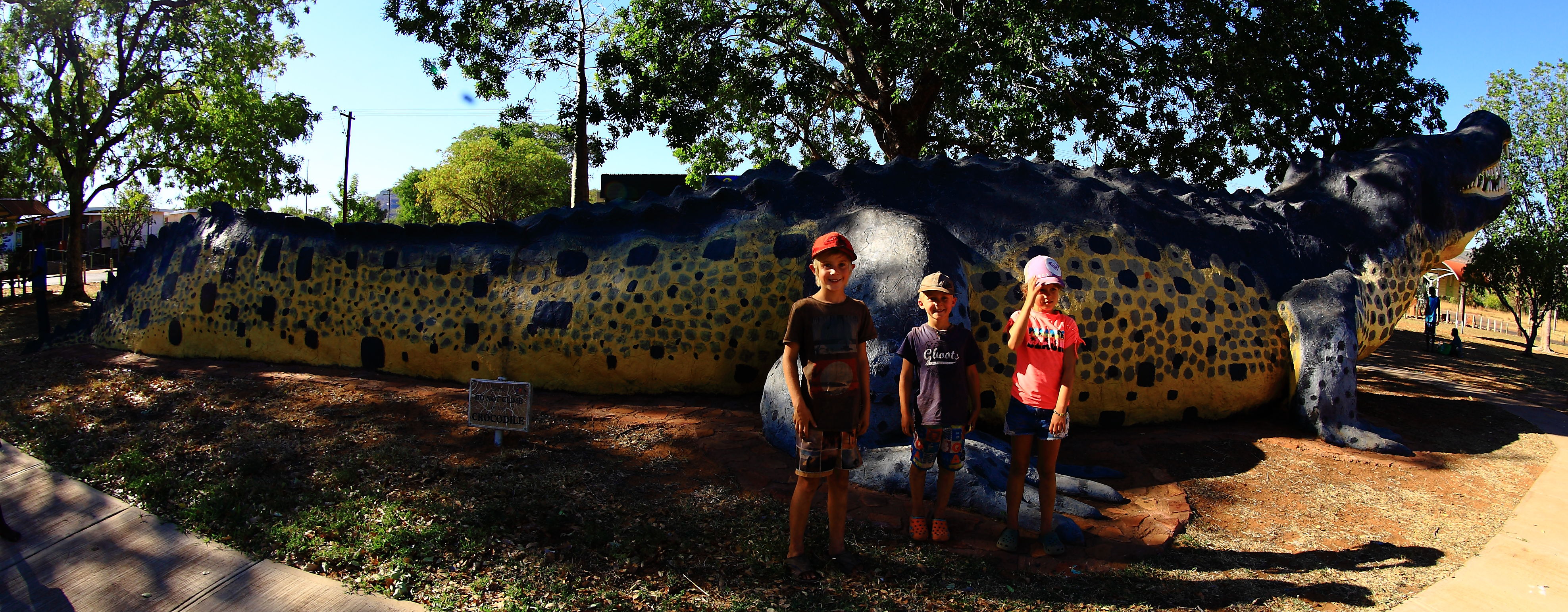
The Big Croc greets all visitors entering Wyndham, and we took a quick photo opportunity, trying our best to dodge the locals selling their carved boab nuts (which, incidentally are quite finely done, just not within our budget).
The local caravan park purported to have the biggest boab, a big claim that couldn’t be bypassed.

The Big Croc in Wyndham

The Big Croc in Wyndham

Five rivers lookout lies behind the town at the top of a steep winding road, 355m up. With a view covering more than 180 degrees and with a bit of looking you can see the Pentecost, Ord, Forrest, Durack, and King rivers. The salt pan near the docks was decorated with patterns we referred to as contemporary local art. Clearly visible from the lookout someone clearly had taken the trouble to literally leave an impression in the sand.


The King river is muddy, and low tide reveals extensive mud-flats. Whilst the port, not so long ago, was a busy point for loading iron ore onto ships, today very little activity could been seen below. We drove back down to the fishing jetty, and witnessed a large saltwater crocodile cruise underneath.
Turning off the main road towards Kununurra, Parrys Lagoon Nature reserve was the next destination. Marglu billabong hosts a bird hide and a number of sizeable saltwater crocodiles too. We watched eagles, pelicans, a jabiru, egrets, grebe, and much more there.
Along this road a chance turning led us to Buttons Crossing, the rocky bank along the Lower Ord river providing a peaceful camping opportunity, where we could watch both types of crocodiles from a close but safe distance. Oscar tried out his frog lure and kept catching Sooty Grunter. Hannah made a humpy from all the wood she found, and Xavier fossicked for stones and animals. Amanda had time to create another of her artistic creations from stone on the riverbank.

This slideshow requires JavaScript.


The next day brought us to Ivanhoe Crossing an impressive curved ford, some hundred metres long, that has been rendered impassable by the council who have placed boulders in the middle of the road to prevent mishap. Clearly the “fun police” were misguided in their calculations as there were fresh tyre tracks when I waded across for a photo. It was tempting but I didn’t want to risk any unnecessary damage so close to Kununurra.

Categories: Adventure, Animal Action, australia, Australian Outback, Big Lap, Discover Australia, Explore Australia, Journey Narrative, Kids Travel, Natural World, Travel, Travel Adventure, West Australia, Wildlife | Tags: , , , , , , | Leave a comment

Blog at WordPress.com.