Animal Action

Kakadu National Park


This slideshow requires JavaScript.

Kakadu is another Northern Territory icon that we had all been looking forward to seeing but having recently heard several accounts of people saying how disappointing it was, without much water and that the big name falls were dry, we were a little apprehensive. Undeterred we chose to base ourselves near the Ubirr rock art site and close to the town of Jabiru. In addition this was close to the famous Cahill River crossing that we would be using to get through Arnhemland to get to the Cobourg peninsula. We dragged ourselves out of Noonamah (Where the hell is Noonamah, being its catchcry) and following a cruisy day looking for crocodiles at any opportunity, drawing blanks each time, we arrived mid-afternoon. A quick dinner and with the sun still in the sky I rushed to see the sunset from the lookout. Despite missing the sunset, a fabulous orange glow set a perfect backdrop for the green tranquil wetlands that stretched before us and as far as the eye could see. Hundreds of visitors, like religious disciples, had paid their homage to the sun god and now made an orderly exit from the park, before they got locked in.

The rock art at Ubirr is breathtaking, and a totally different style to that found in the Kimberley or even the Jawoyn art from nearby Katherine. Often referred to as X-Ray art, their depictions of water creatures include their bones and internal organs, often to depict the choicest part of the barramundi or pig-nosed turtle. Amongst the numerous galleries that the public can access are murals depicting stories that have lessons about behaviour, older ones depict images of extinct animals such as the thylacine, and some are just chest-beating efforts of artists showing that they can paint the largest fish, or can paint it the highest up the wall. Another depicts the Rainbow Serpent common throughout aboriginal heritage as the creator. One particularly interesting piece shows a woman with swollen arms and legs, a reference to radioactive sites that made people sick when visited. The controversial uranium mine, Jabiluka is approx. 45km away. A two hour Park Ranger tour by Glen was fascinating as he imparted his extensive knowledge of the subject.

A few hours were spent at Cahill Crossing fishing, unsuccessfully, but mainly watching the crocodiles who, at high tide, congregate at the crossing waiting for the waters to cross the road. When it happens a feeding frenzy commences as they prey on the hordes of fish that have been waiting to move upstream too. It was interesting to see them using their front feet to shepherd the fish towards their mouths, and as soon as they touch one a quick snap sees it disappear pretty quickly. The only thing I caught was an aboriginal spear that was floating down the river!
Despite the park being a rich source of indigenous rock art the public can only access a couple of sites, the other one being Nourlangie Rock. We took advantage of the Parks ranger guided tour. Christian gave three different talks at different points in the park, about the landscape formed by the aborigines and how they lived, then provided some insight into the most famous art piece, painted in 1963/1964 by one of the last true elders in the area, in a last-ditched effort to re-ignite a strong cultural spirit. In his life the number of people living traditional ways had dwindled from 2,000 to around 300. Two languages have been lost in the region since 2000, and another is due to die when the last existing person speaking it oases away. n the next decade there will be no more people from pre-contact days with the “White fella”, when the cultural degradation began as they were exposed to Western ways.

Kakadu and Arnhemland communities do, however, remain culturally strong despite this. Much of their land has been retained or reclaimed to use as they wish, and permits are required to enter many of these areas.

Christian also talked about a famous dig in one of the living areas, performed in the 1980’s. When locals turned up periodically they would ask what the ancestors had left for them to see that day. Looking at some poor archaeology undergraduate trying to identify a tooth dug up from thousands of years ago, they would ask what they were doing. When told the children would grab the tooth and identify it instantly. Another stone tool dating back almost 20,000 years was shown to them and they would reply that the stone didn’t come from around here. They would then explain it came from a region at least two days walk away. Where else on earth can an archaeologist tap into 20,000 years of living knowledge? Language is the law, and the law is the language explained Christian. When nothing is written down in the culture all stories and language have been passed down from all previous ancestors before. Plants only have names if deemed important enough by the ancestors.

We listened for 3 hours and could have spent a day listening to his passionate stories. Being white too he was very wary of ensuring he told stories correctly. The kids were enthralled to the end, and when he pulled out his collection of rock artefacts they were in heaven!

That afternoon we decided to take a path less travelled and drove some 70km along a 4WD track from the Old Jim Jim road back to Jabiru. This was the Kakadu I was hoping to see, beautiful lily and lotus lined billabongs, rich in birdlife, Jabirus, egrets, magpie geese, radjah shelducks and lots more. A few river crossings too to make it interesting.

Kakadu wasn’t disappointing in the slightest.


Categories: Adventure, Animal Action, australia, Australian Outback, Big Lap, Camper Trailer, Discover Australia, Explore Australia, Journey Narrative, Kids Travel, National Park, Natural World, Northern Territory, NT, Photography, Photos, Travel, Travel Adventure, Walks, Wildlife | Tags: , , , , , | 2 Comments

Wyndham to Kununurra

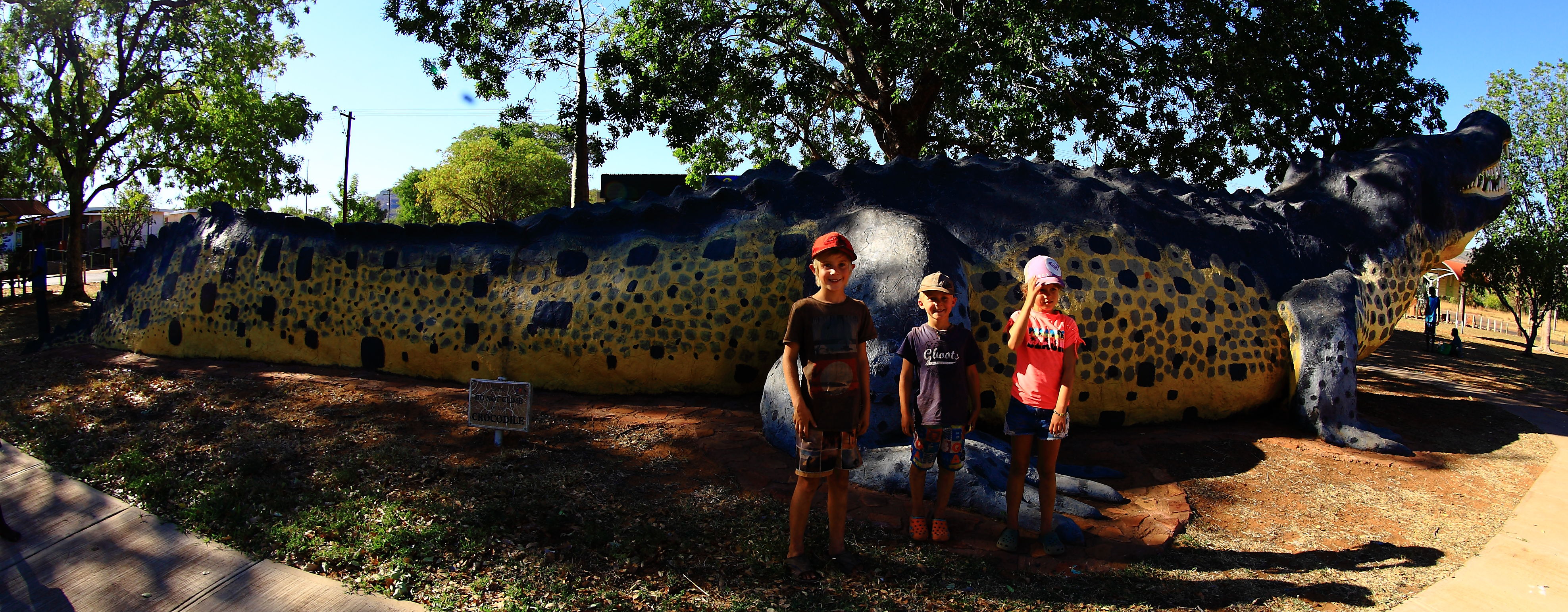
Although the Gibb River Road had formally ended when I dashed to Kununurra to get a battery replacement for the car, leaving El Questro we turned north towards Wyndham, home of the Big Croc, with the intention of seeing the five rivers lookout. It was nice to be driving on bitumen again.

This slideshow requires JavaScript.

The Grotto is a deep pool in a small gorge just off the road to Wyndham. Over a hundred steps take you to a little swimming oasis. Steep cliffs line the sides of the Grotto, and the tree-lined dry creek bed leading from the pool was full of birds, including the Gouldian finch. We spotted red and black-headed varieties. Mosses and ferns covered one wall, tree roots clinging to the rock descended down to seek water below. The scene was somewhat reminiscent of the ancient ruins of Angkor Wat in Cambodia.
The Big Croc greets all visitors entering Wyndham, and we took a quick photo opportunity, trying our best to dodge the locals selling their carved boab nuts (which, incidentally are quite finely done, just not within our budget).
The local caravan park purported to have the biggest boab, a big claim that couldn’t be bypassed.

The Big Croc in Wyndham

The Big Croc in Wyndham

Five rivers lookout lies behind the town at the top of a steep winding road, 355m up. With a view covering more than 180 degrees and with a bit of looking you can see the Pentecost, Ord, Forrest, Durack, and King rivers. The salt pan near the docks was decorated with patterns we referred to as contemporary local art. Clearly visible from the lookout someone clearly had taken the trouble to literally leave an impression in the sand.


The King river is muddy, and low tide reveals extensive mud-flats. Whilst the port, not so long ago, was a busy point for loading iron ore onto ships, today very little activity could been seen below. We drove back down to the fishing jetty, and witnessed a large saltwater crocodile cruise underneath.
Turning off the main road towards Kununurra, Parrys Lagoon Nature reserve was the next destination. Marglu billabong hosts a bird hide and a number of sizeable saltwater crocodiles too. We watched eagles, pelicans, a jabiru, egrets, grebe, and much more there.
Along this road a chance turning led us to Buttons Crossing, the rocky bank along the Lower Ord river providing a peaceful camping opportunity, where we could watch both types of crocodiles from a close but safe distance. Oscar tried out his frog lure and kept catching Sooty Grunter. Hannah made a humpy from all the wood she found, and Xavier fossicked for stones and animals. Amanda had time to create another of her artistic creations from stone on the riverbank.

This slideshow requires JavaScript.


The next day brought us to Ivanhoe Crossing an impressive curved ford, some hundred metres long, that has been rendered impassable by the council who have placed boulders in the middle of the road to prevent mishap. Clearly the “fun police” were misguided in their calculations as there were fresh tyre tracks when I waded across for a photo. It was tempting but I didn’t want to risk any unnecessary damage so close to Kununurra.

Categories: Adventure, Animal Action, australia, Australian Outback, Big Lap, Discover Australia, Explore Australia, Journey Narrative, Kids Travel, Natural World, Travel, Travel Adventure, West Australia, Wildlife | Tags: , , , , , , | Leave a comment

Gibb River Road – Part 1 (Windjana Gorge and Tunnel Creek)

Finally, with supplies stocked to the gunnels, Gerry cans all full, we set forth from Broome to conquer the Gibb River Road. At least that’s what it felt like given we had prepared for 3-4 weeks away from shops and very few fuel and water stops.
The Gibb River road, heading north from Broome, commences just before you enter the town of Derby, and barely two hundred metres before the turnoff was our first scheduled stop to see the Boab Prison Tree.
At the same location is a historic cattle trough fed from artesian water sources, long enough to water several hundred cattle at once.

Turning into the Gibb River Road (GRR) the excitement levels increased, particularly as the road was primarily bitumen to our first camp at Windjana Gorge. My illusion of the GRR being a remote and isolated experience was shattered immediately as we drove around the camp looking for a site. It was busy and this was early in the season, and with a few exceptions the next few weeks didn’t change. From the Britz and Apollo hire cars and vans, through to the mainstream 4WD vehicles, everyone seemed to be coming through. There was even a Barina!

Windjana gorge is home to a population of approximately 150 freshwater crocodiles, so we were all keen to get our first croc sighting. A very easy walk takes you past cliffs of Devonian limestone encrusted with the fossilised remains of ancient animals, then through shaded forest for a couple of kilometres up the gorge. The crocs were there sitting on the beaches, not overly perturbed by our presence, and the sheer narrow gorge was breathtaking. Hannah even found what the ranger believed was a croc tooth on one of the pebbly river beaches there. A night excursion to the riverbank with a powerful torch revealed up to 100 pairs of eyes in one count on a short stretch of the Lennard River.

Tunnel Creek is a short drive from Windjana, a few hundred metres long, that can be traversed with the aid of a good torch, involves a little rock scrambling and a few shallow wades. It too has a population of about 6 freshwater crocodiles and we caught a couple of glimpses in the deep pools, but they sink into the murky depths as you approach. There is rock art at both ends if you know where to look and this was our first chance to see close up artwork, some of which has been there for thousands of years.

The story of Jandamarra is one that closely links the two sites together. As a youngster he was nicknamed “Pigeon” by his boss, and became a top horseman, shearer and a crack shot with a rifle. Working at Lillimooloora station he became good friends with a white man called Richardson. When the station later went bankrupt, Richardson joined the police force and took Jandamarra with him as a tracker. The two of them ended up tracking down Jandamarra’s own Bunuba tribesmen after they had resisted incursions by new settlers. Having captured most of the elders who had initiated him as a youngster Richardson chained them together for seven days, ready to collect a reward. After much pressure from the elders Jandamarra killed his partner, released the Bunuba elders and fled. Seriously injured in a battle in Windjana Gorge a week later he fled, taking refuge in Tunnel Creek for some years. On 1st April 1897 he was shot dead by another aboriginal tracker near the entrance to Tunnel Creek, by which time most of the Bunuba had been eradicated in the area by settlers. In Tunnel Creek there is an image of a pigeon etched into one of the cliff walls, for those who look close enough, a little reminder of the struggles that the indigenous people have suffered over the years.
What an interesting and fascinating start to our Gibb River Road adventure.

Categories: Adventure, Animal Action, australia, Australian Outback, Big Lap, Discover Australia, Explore Australia, Journey Narrative, Kids Travel, National Park, Photography, Photos, Travel, Travel Adventure, West Australia | Tags: , , , , , | 1 Comment

Waterhouse Point (Tasmania) – Flashback

Leaving Deep Creek we checked out some of the other sites in the park and were very surprised to find that many of the beachfront ones were totally empty. Whilst visiting the Stumpys sites (there are 4) the kids got out to try to pump an old bore handle with varied success as the photos show.

To the North-east of Bridport in North Tasmania there are a few camping spots within the Waterhouse Conservation area. Driving around some of these we were very surprised to find some of the beachfront camps empty. After visiting Stumpys 1 to4 we ended up settling for Waterhouse Point. Once again we were the only people there until a late arrival. The beach was home to thousands of soldier crabs who fled when the kids descended, burrowing rapidly in a clockwise circular motion into their holes. At the far end of the beach the kids searched through knee-deep weed for “sea treasures”.

This slideshow requires JavaScript.

The site looked like a great place for Tassie Devils so I got the camera ready, rugged up and sat quietly. My hopes sank when a feral cat showed up but when I scared it off as soon as the sun set a particularly brazen brushtail possum swaggered into the camp, and after repeated attempts to scare him off I decided it wasn’t the night for devils.

This slideshow requires JavaScript.


Categories: Adventure, Animal Action, Australian Outback, Beach, Discover Australia, Explore Australia, Journey Narrative, Kids Travel, Location, National Park, Offroad, Photography, TAS, Tasmania, Travel, Travel Adventure | Tags: , , , , | Leave a comment

Cape Range National Park

Coral Bay  was a short drive north from Waroora so we had to go and have a look. The caravan parks looked way too crowded for us so we headed out towards Five Finger Reef for a snorkel. The road looked very sandy so we quickly unhitched the trailer in the car park, let down the tyres and headed out. Luckily we did unhitch as the going got pretty soft and we witnessed a couple of bogged cars that managed to get out before they needed our assistance.

Some mindless fisherman had discarded a partially filleted reef shark on the pristine beach, but once in the water we were treated to beautiful coals and fish, even a dolphin cruised past the beach when we exited. A quad-bike tour roared along the beach and soon we were on our way again. The recent cyclone meant the Yardie Creek river crossing was out of the question so we took the long road back via Exmouth to Cape Range.

Our destination was Osprey Bay, only recently re-opened after refurbishment, about 10km north of Yardie Creek. One of the few places where land fishing was allowed, but also offering coral reef for snorkelling right in front of the campsite. Many hours were spent with the kids looking for lionfish, turtles, crayfish and much more besides. We saw leopard sharks, reef sharks, Hannah and Oscar even came back from a snorkel together boasting that they had patted a friendly turtle! We even had an invasion of jellyfish who came in one morning with the tide.

I explored Pilgonaman Gorge, and saw many black-footed rock wallabies. The walking is hard work and a 4WD is required to get to the gorge entrance. The hike up the gorge at Yardie Creek was easy for all of us and we got to see fruit bats, a western bower bird and dozens of budgerigars. We marvelled at the abilities of the rock wallabies who had scaled the gorge cliff faces.

The nearby site called Oyster Stacks offers great snorkelling between and around 5 oyster coated limestone pinnacles that jut out of the water at low tide. Whilst a little tricky underfoot to get in, a snorkeller is immediately rewarded with rich fish and coral life only metres from the shore.

Turquoise Bay is the next beach up the coast, offering more friendly, albeit less diverse, snorkelling from a sandy shore. Potentially dangerous currents are clearly signposted here so a quick briefing for the kids made it an enjoyable visit. The kids got their first close up of a shark, encountering two white-tip sharks.

Five days in Cape Range flew by, then we got the bad news about a Cyclone that had formed off the coast and was heading towards us. Our new friends, Helen and Matt, who we met at Osprey Bay confessed over dinner that they had a knack of being “drought breakers”. Wherever they go the rains follow.


Categories: 4WD, Adventure, Animal Action, australia, Australian Outback, Beach, Big Lap, Discover Australia, Explore Australia, Journey Narrative, Kids Travel, National Park, Natural World, Offroad, Photography, Photos, Travel, Travel Adventure, West Australia | Tags: , , , , , , | Leave a comment

Francois Peron National Park (Shark Bay)

The nearest town to re-stock fuel and supplies was Denham, though it turned out to be smaller than expected. It is on a well-worn tourist route for travellers heading for the Dolphin Conservation resort at Monkey Mia within Shark Bay. We used the campsite at Big Lagoon, in the Francois Peron National Park, as a base to explore for a few days. We were excited at the prospect of seeing Bilbys, Mallee Fowl and Dugongs in the wild, but they all proved to be very elusive.


After a long day’s drive we got horribly bogged at the campsite looking for the perfect spot. We ended up having to unhitch the trailer to get the car out then winch the trailer out. A bit of extra practice is always good!

The lagoon was surprisingly devoid of fish life but most mornings a solitary dolphin would cruise past the channel before any boats got launched. A couple of eagle rays cruised beneath me as I swam across the channel. The flies had not abated and to keep it interesting there was also a scattering of biting march and sand flies loitering in the Francois Peron National Park.

An afternoon’s excursion took us deeper into the national park on a 4WD track. At the northern tip, Cape Peron we encountered the worst concentration of flies yet making our stop purely long enough to see the cormorant rookery on the beach beneath the cliff. Rather than walk the 1km to Skipjack Point we drove. From there two lookout platforms offer fantastic vantage points to view sharks, turtles, dolphins, and sometimes dugongs. We saw all but the latter.

On the return we checked out the beaches at Bottle Bay, The Gregories, and South Gregory, all beautiful and great campsites, then on the east coast at Harold Bight the free camp looked very quiet but the sand was also very soft and deep.

We enjoyed Skipjack Point so much we returned the next day for more shark spotting and were not disappointed. We also saw a giant shovelnose ray in the shallows and an eagle ray treated us to an aerial acrobatic display, leaping clear of the water repeatedly. We fished at The Gregories on the way back and caught dinner (whiting and a 34cm yellowfin bream). We also visited Krasker’s Tank and learnt about the unfortunate one-legged entrepreneur, Leon Krasker, who perished trying to get to the water tank in the middle of the arid landscape. On one of his weekly 70km trips from Denham to Harold Bight, in1916, to buy pearls and collect mail, his horse, Battler, threw him, breaking his good leg (the other was made from cork). Before  he died he documented what had happened.

A visit to snorkel Little Lagoon was followed by a look at the mangrove outlet. Supposedly full of stonefish this is the place to snorkel as the main lagoon itself was surprisingly devoid of much life.

We caught squid from Denham jetty one night (well Hannah did) and visited the artesian bore hot tub at the old homestead in the park. This 40 degree tub is a must visit place but takes time to get in!


Categories: 4WD, Adventure, Animal Action, australia, Australian Outback, Beach, Big Lap, Camper Trailer, Discover Australia, Explore Australia, Journey Narrative, Kids Travel, Mitsubishi, National Park, Natural World, Offroad, Photography, Photos, Travel, Travel Adventure, West Australia | Tags: , , , , , , , , , , | 1 Comment

Bushflies

Firstly, this blog comes with a warning. There is some detail that may induce nausea with those of a delicate disposition.


This slideshow requires JavaScript.

The bad news is that the flies have finally got under our skin. Not literally, thank goodness, but close as they are crawling into our ears, and they love squeezing their bodies into the corners of our eyes, nice and snug, so that legs get left behind when you wipe them out. A fly rapidly making its way into your ear is alarming enough but when several of them attempt to do so simultaneously it becomes quite distressing. Worse still the amplified crunch that results when your finger finally denies them further access. All of us have also experienced the doubled over coughing and spitting fit that brings tears to the eyes as we try to dislodge a tracheal intruder.

Any cuts will be swarmed with voracious flies within seconds of exposure to the open air leading one to wear new fashion accessories that we have christened “fly rings”. Poor Amanda, at times, felt like  her skin was crawling.

We all have fly nets, though mine (an SA model) appears to only filter out the big blowflies and not the recent wave of smaller bushflies that have arrived in their swarms.

It started just after the cyclone just prior to Easter. At the Pinnacles we were initiated into the outback fly plague. At Sandy Cape they got a little more persistent. From then on they have been consistently bad, the locals even conceding that this is the worst and most prolonged that they can remember.

I’m jumping ahead of my blogs but at Cape Peron it became unbearable with Fifty Toes constantly running back to the car where we could control their numbers. Uncomfortable yes, but  one  evening camped on the beach at Waroora Station, a few days later, we didn’t bother with the awning. The weather was beautiful and yes, there were plenty of flies, but by now we are used to having at least a dozen flies crawling over our faces at any one  time, crawling across  your lips, in the eyes and seeking entry into ears, whilst having a conversation with someone. We have all perfected our own personalised versions of the “Australian Wave” but as soon as the dinner was served into bowls, wave after wave of kamikaze bushflies plummeted into the sauce. For each one that was  scraped out with a knife or finger,  three more had sacrificed themselves. We tried in vain to eat from our bowls under our fly nets. I gave up, figuring that the additional protein would add an interesting crunchy texture. When the crunchiness became the dominant texture, revulsion got the better of us all and in unison we dashed for the car again, cranked up the aircon and ate dinner in the car.

As we sit out Cyclone Quang, we are optimistic that the winds will have sorted the flies out. In recent days we have laughed at people wearing fly nets because we no longer need to wear them. Words can only begin to describe what it has been like but to conclude on a positive note if you ever see me chuckling to myself I am probably remembering the sight of the ladies in bikinis sunbaking on Kalbarri beach with fly nets on their heads, or the canine in Carnarvon walking around wearing one.

Categories: Animal Action, australia, Australian Outback, Big Lap, Discover Australia, Explore Australia, Journey Narrative, Kids Travel, Photography, Photos, Travel, Travel Adventure, WA, West Australia | Tags: , | 1 Comment

Murchison House Station

Murchison House Station was founded in 1858 by Charles von Bibra to provide meat and wheat to lead miners at Galena, beef to the growing Perth market and remount horses to the British army in India. The original homestead “von Bibra’s cottage” was built by Charles von Bibra with convict labourers in 1858. Using local materials it was constructed from Tumblagouda sandstone and mud bricks. The original shearing shed also dates back to the 1860’s. In its heyday up to 35,000 sheep would be brought to this shed for shearing. Features inside include the extensive use of Oregon pine and the 100 year old wool press and wool classing table.

Located only a few kilometres from Kalbarri it served as our base for a few days while exploring the area. Unfortunately for us the recent rains had caused the river Murchison to flood and access to the opposite side of the river was closed. Due to school holidays there were plenty of kids around of similar ages to ours. Many hours were spent in the goat shed, then rounding them up again when Oscar accidentally let them out.

Then the home-made billycart was dragged from a shed and more hours spent riding around the courtyard. Evenings were spent around the campfire. It was nice to be able to have one after such a long time and those marshmallows tasted particularly good after the wait. Did I mention the bushflies? Oh and the snake Hannah found at night that looks suspiciously like a western brown. Can anyone confirm its identification for us?

Categories: Adventure, Animal Action, australia, Australian Outback, Big Lap, Discover Australia, Explore Australia, Journey Narrative, Kids Travel, Photography, Photos, Travel, Travel Adventure, West Australia | Tags: , , , | Leave a comment

Perth- a very brief visit

As well as servicing the car and trailer we spent some time exploring a few spots in Perth. Amanda’s school friend Justine and other half Steve kindly offered to put Fifty Toes up in their house so for us this was a luxurious treat.

First stop was a visit to Point Walter on the Swan river where we were lucky enough to see a small pod of dolphins cruising slowly back towards the ocean. The kids swam and then fished off the jetty with tackle they had found and extracted from amongst the pylons and wooden boards. A few toadfish was all they could catch but their squeals of delight were a pleasant change from the fighting squeals we often get in the car.

I took the boys to SciTech where three hours just evaporated as we immersed ourselves into a really hands-on scientific experience. The boys favourite was the slime show, but we watched the planetarium show as well, and spent most of the time playing with things like gyroscopes, plasma balls, speed radars (for the record I threw a tennis ball at 100km/h), and much much more. it was so engrossing I forgot to even take any photos. Great value and well worth a visit for all ages up to teens and beyond.

We spent some time in Fremantle too. One of Xavier’s best friend’s family flew in from Sydney and we explored the markets that have everything from fresh tropical fruit and vegetables to indian headdresses! Fish and chips is a local institution so we sat on a boat in the harbour and listened to the live music as we ate our lunch.

Then we had to visit Rottnest Island. An early start saw us boarding the ferry at 7.30am and queueing to hire bikes by 8.10 on the island. First stop, Little Parakeet bay for some snorkelling, then off on our bikes again. Quokkas are the endemic marsupials of the island and we found heaps of the tame little creatures everywhere. Their cute faces and endearing nature could not be missed resulting in many stops along the way.

Oscar, though, was the only one with the willpower to make it all around the island on his tiny single gear bike, once again showing us his enthusiasm on two wheels. Whilst the others turned around half way the two of us got to the western end of the island where we saw the seal colony, king skinks, and even another dugite that I nearly trod on.

That night, we enjoyed dinner with Justine and Steve in Fremantle and saw some of the street theatre festival that was on for Easter. Mr Spin span out his show for too long but his final stunt was good, juggling with a glass of water balanced on his forehead whilst riding a 7 foot high unicycle!

Time was fast running out but we had time to visit Kings Park, commanding glorious views over the city CBD and the Swan river, amazing botanical gardens, and catch up with two new sets of friends from Cape Le Grand.

Dale and Mel had invited us over for a barbeque which was a lovely opportunity to catch up while all the kids paired off again and went wild in their swimming pool.

Ian and Jackie had pretty much been feeding everyone at the Cape Le Grand campsite and after having us over for dinner one night, insisted we stayed with them before leaving Perth so after farewelling Justine and Steve we visited them again just as the weather started to deteriorate again. We’re hoping they join us on the Gibb River road in a month or so!


Categories: Adventure, Animal Action, australia, Australian Outback, Big Lap, Discover Australia, Explore Australia, Journey Narrative, Kids Travel, Natural World, Photography, Travel, Travel Adventure, West Australia | Tags: , , , | 3 Comments

Unreported shark attacks along the south coast!

On our travels along the southern coastal bits of the country we have noticed an alarming number of shark attacks that go unreported. The evidence of these attacks can easily be found as the poor victims body parts are strewn across many of the beaches we have visited.

I have even personally witnessed one such attack in the water in Sydney and can report that luckily the victims are already deceased. The sharks are actually just doing their duty of cleaning up the dead carcasses of cuttlefish. Cuttlefish have a relatively short lifecycle usually only living 2-3 years. They breed and die shortly afterwards, providing a vital food source to any hungry scavengers. All that is left after the clean-up process is the brittle internal cuttlefish bone that can be found washed up on the beach. We have frequently found these cuttlefish bones bitten in half, or covered with shark teeth indentation marks (see photo).

Basically it is the case of nature taking its course and nothing sinister as the heading might have implied.

Victims of shark attacks

Victims of shark attacks


Categories: Animal Action, australia, Beach, Discover Australia, Explore Australia, Journey Narrative, Kids Travel, Natural World, South Australia, Tasmania, Victoria, West Australia | Tags: | 2 Comments

Create a free website or blog at WordPress.com.