australia

Katherine and Edith Falls

Further north the attraction of the world famous site of Katherine gorge was one that couldn’t be overlooked. First though we had to visit the Katherine Hot Springs and though we had barely finished breakfast everyone jumped in. They are a very comfortable temperature, rather than hot, running through a shaded pandanus-lined embankment, offering approximately 200m or more fun-packed streams, cascades and small waterfalls. The kids might have spent all day but we moved on to Nitmiluk National Park. More caravan park than national park, this was a bit of a disappointing start for us, probably because we hadn’t researched enough, but when we returned from an afternoon walk to see the Jawoyn rock art to find a tent a couple of metres from the back steps on one side and a caravan reversed on top of the other side, the harsh reality of the commercialism of a popular site hit home. It was school holidays too.


We saw the gorge itself from a couple of vantage points, the entrance, Pat’s lookout, then I did a solo 22km walk to Lily Ponds which overlook one of the higher gorges. Maybe we had overdosed on gorges recently but compared with those we had already encountered in Karijini and on the Gibb River road we found Katherine to be quite average. The Jawoyn art was special though, and worth wading across the river for from Pat’s Lookout. I found some more on the walk to Lily Ponds but the highlight of that walk were the ponds themselves that offered a safe place to swim, and I didn’t see a soul all day. The only visitors were either kayaking up the river or on expensive boat tours. The kids meanwhile were cooling off in the “resort” pool back at camp.

Only too happy to make a hasty exit the next day a short drive brought us to Edith Falls. This is another popular tourist venue but the campsite was a delight run by two gorgeous ladies, who frantically cycled around the campsite making sure there were vacancies. A short walk from the camp leads to the bottom lake, probably 150m across to the waterfall, maybe 200m wide. It was deep but undeterred Oscar led the way with a recently re-acquired strong front crawl. It was deep and murky but he powered on and was the first to jump off the rocks at the waterfall back into the lake depths. Crocodiles live here too but they wait until the 7pm curfew before coming out to enjoy the waters.

We also walked up to the upper pool, even more popular with tourists, and quite a selection of rock outcrops, allow jumping opportunities up to 15m high into another unfathomable pool. Five metres was about the limit I could manage.

We met “JKSJ” another travelling NSW family that we first met in Emma Gorge, always good for the kids to have some socialising time back at camp.

Rob the ranger gave an interesting talk on fire management in the park that evening, explaining the challenges and complexities associated with using burn-off to manage biodiversity and protecting the park. The impact and frequency of fire on different habitats is all taken into consideration but Parks and Wildlife now rely on following aboriginal guidance given that the environment here is man-made and has been shaped over 20,000+ years by aboriginal burning regimes. All the rangers we have met so far have been inspirational and so passionate that it is a pleasure to listen to them. Their breadth of knowledge is astounding too

Categories: 4WD, Adventure, australia, Australian Outback, Big Lap, Camper Trailer, Discover Australia, Explore Australia, Journey Narrative, Kids Travel, National Park, Natural World, Northern Territory, NT, Photos, Travel, Travel Adventure, Walks, Wildlife | Tags: , , , , , , , | 2 Comments

Zebra Rock Mine, Lake Argyle and beyond

Not far from Sawpit Gorge was the site of the first gold rush in WA, and Old Halls Creek ruins provide a place to explore some of the heritage from that era. Unfortunately, with the prospect of a long drive that day we didn’t stop.
The Duncan Road is a famous 440km stretch of dirt road developed to promote the beef industry in the 50’s and 60’s. Possibly the worst ever memorial, a salmon pink concrete monstrosity, signposted as the Beef Road Monument, lies at the northern end of the road. Apart from that it was a fairly monotonous drive north, corrugated for much of the way, across landscape that didn’t offer much more than some undulating scrub, flat grazing land and lots of termite mounds.
A few kilometres before the end we found the Zebra Rock Mine, an audacious endeavour, commenced 6 years ago by KIm and Ruth Duncan, who hand pegged the 10km square themselves, mine during the wet season and during the dry season pursue other ventures such as the campsite, mine, lake and fishing tours, all important for keeping the operation going. The fish and chips was extremely good despite my reservations about eating a catfish (known as Silver Cobbler), and their scones looked mouth-wateringly good too.
Zebra Rock itself is a unique ancient rock only found in this area, the only other locations now being (or soon to be) underwater in nearby Lake Argyle. At 1.2 billion years old geologists can’t agree whether the unique light/dark colouration patterns are caused by sedimentation or other processes. We scoured the creek bed like hundreds of tourists before and managed to find a couple of small pieces for memories.
Lake Argyle is a huge artificial lake, the second largest artificial reservoir in Australia. Aside from the caravan park overlooking the lake there is very little else there. A lookout gives you an insight to its size, but the best view would be from the air. We had lunch in a very green reserve just below the dam wall, explored the numerous bowerbird bowers for exotic contents (no jewellery yet!) and watched crocodiles cruising the crystal clear waters exiting the dam in the Ord river.
The Zebra Rock Mine has an interesting gallery showcasing many differents types and patterns of the rock, but there are also photos of a young Kim wrangling wild buffalo in the 70’s by hand. It was quite a lucrative, albeit dangerous pastime and when capturing over 100 a day he could earn up to $10k a week! One photo showed a journalist from a national paper in Kim’s buffalo-hunting Landcruiser, jotting notes in a notepad, while Kim ties up a buffalo. That car is still running today and obviously is very dear to Kim’s heart.
On the road north we only had one diversion to see Gregory’s tree. This boab tree was a sacred site for the local aboriginal tribes, however, when early explorer Augustus arrived in 1855 he established camp here as a base. The day they arrived and left is ornately carved into the trunk, an early example of European vandalism, but ironically now has historical significance. Over the 8 months they spent there they explored the Victoria River catchment and travelled inland some 500km to the edge of the Great Sandy Desert.

Categories: 4WD, Adventure, australia, Australian Outback, Big Lap, Camper Trailer, Discover Australia, Explore Australia, Journey Narrative, Kids Travel, Northern Territory, NT, Photography, Travel, Travel Adventure | Tags: , , , | 2 Comments

Bungle Bungles (Purnululu National Park) and beyond

Soon after a restock, and refuel stop in Kununurra we headed south for Purnululu National Park, or the Bungle Bungles. Stopping briefly at an overnight rest stop where a little spotted snake visited our camp, we headed onto the fairly corrugated road early next morning. We past a Ford Triton with three wheels in a dry creek crossing, another victim of the corrugations, and set up camp.


The Bungle Bungles are irresistible and unforgettable. With every twist and turn of the painfully corrugated road going into the Purnululu national park you are looking for the famous orange and black stripey beehive shaped hills. When you finally get there, at least an hour’s drive from the highway, the sheer magnificence of the outcrop demands that you stop and absorb the visual feast for a few minutes. It’s nonsense to believe that it can only be appreciated from the air and many of the walks within the park allow the visitor to appreciate the narrow gorges and other gems hidden from an aerial view.

We chose to spend our limited time in the park exploring, as usual, as much as possible, which meant a lot of footwork. Eight months into this trip our footwear was looking pretty sorry for itself and we are all promising that the next big city, Darwin, will bring new shoes. Xavier has even resorted to walking barefoot through some rocky gorges, whilst the rest of us hobble through with runners sporting gaping holes in the sides or sandals with more holes than when we bought them.

Echidna Chasm is a narrow gorge, in some sections barely a few metres wide, hidden behind a stand of palm trees, that penetrates a bastion of rock for hundreds of metres. A resident great bowerbird has its bower on show right next to the footpath near the gorge entrance. These ritual display sites are artistic masterpieces, built and used by the male to attract a mate. They run back and forth through the arch made from carefully positioned upright twigs. At both ends the bower is decorated with silver, white and green artifacts, the latter placed either side of the bower entrance. Often white objects will also be placed in the centre of the bower. Broken glass, bones, plastic, snail shells, tin foil, paper, seeds and even metal pipe can be found lying amongst the debris. The kids have tried placing yellow flowers amongst the objects and watch in delight from a distance as the bird grumpily discovers and removes them promptly.

For a couple of hours around midday a shaft of sunlight penetrates the gorge, and the resulting warming orange glow is a visual spectacle not to be missed. A chamber inside the gorge lights up at this time making it a popular place for photographers. Beyond the chamber the narrow gorge continues to wind its way through the rock but becomes impassable due to massive boulders.

Travelling back south from here we stopped to walk to Mini Palms gorge, again accessed via a palm forest concealing the entrance.

At the other end of the park lies Piccaninny Gorge, and within this area there are a number of walks. An easy introduction was a 400m walk to the Domes, ending at a small murky puddle in an enclosed chamber. Despite looking hard we couldn’t find the rock art here. Further down the track was Cathedral Gorge. Xavier counted 37 dead cane toads in the dry creek bed, solid evidence of the alien invasion that the Kimberley is experiencing, and destroying the local fauna. The pool at Cathedral Gorge was bigger but equally uninviting due to a layer of scum on the top. Bored tourists tossed stones into the pool to break the scum layer. The immense rock roof, supported only from the surrounding walls, almost totally encloses the space, giving it that cathedral feeling.

Beyond Cathedral Gorge, some longer walks take you up Piccaninny Creek, and Snake Creek. Piccaninny Lookout and the Window were all we could manage before I realised I had misplaced my camera tripod. Despite retracing my steps without luck, our time here had run out and we had to leave the park to head south.


Categories: Adventure, australia, Australian Outback, Big Lap, Camper Trailer, Discover Australia, Explore Australia, Journey Narrative, Kids Travel, National Park, Natural World, Photography, Travel, Travel Adventure, Walks, West Australia, Wildlife | Tags: , , , , , , , | 3 Comments

Wyndham to Kununurra

Although the Gibb River Road had formally ended when I dashed to Kununurra to get a battery replacement for the car, leaving El Questro we turned north towards Wyndham, home of the Big Croc, with the intention of seeing the five rivers lookout. It was nice to be driving on bitumen again.

This slideshow requires JavaScript.

The Grotto is a deep pool in a small gorge just off the road to Wyndham. Over a hundred steps take you to a little swimming oasis. Steep cliffs line the sides of the Grotto, and the tree-lined dry creek bed leading from the pool was full of birds, including the Gouldian finch. We spotted red and black-headed varieties. Mosses and ferns covered one wall, tree roots clinging to the rock descended down to seek water below. The scene was somewhat reminiscent of the ancient ruins of Angkor Wat in Cambodia.
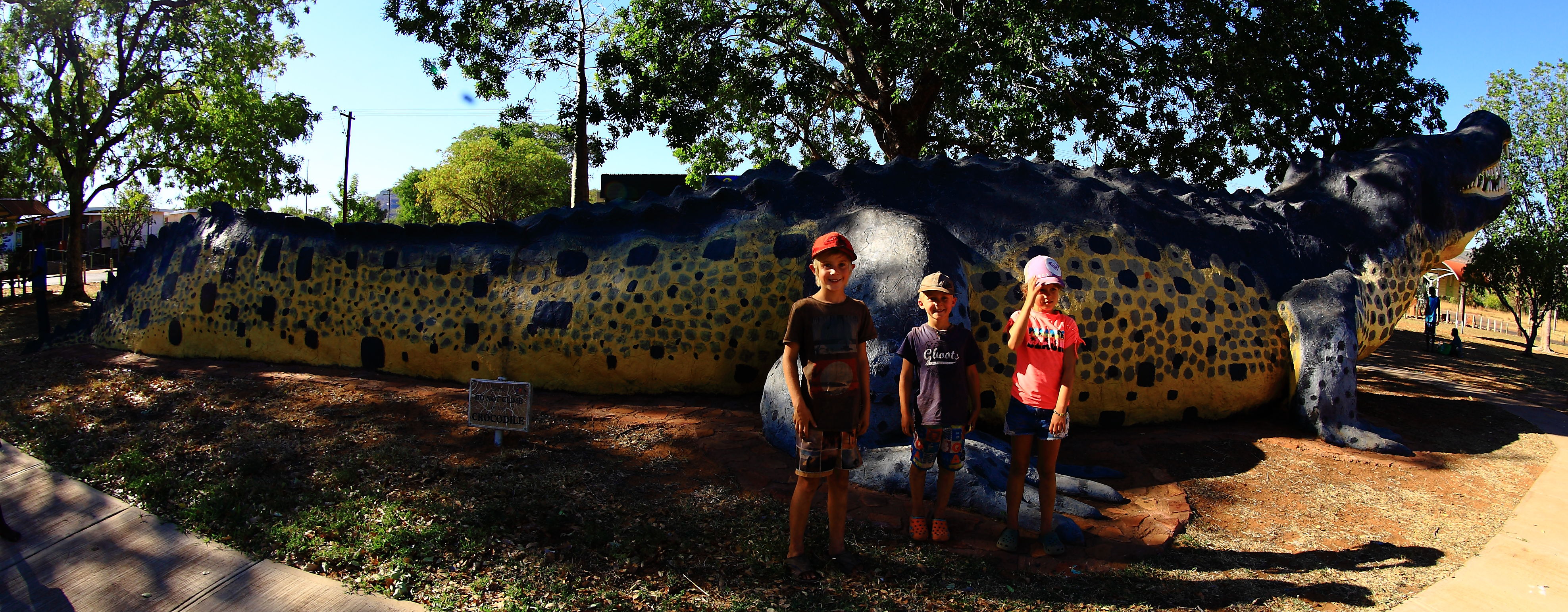
The Big Croc greets all visitors entering Wyndham, and we took a quick photo opportunity, trying our best to dodge the locals selling their carved boab nuts (which, incidentally are quite finely done, just not within our budget).
The local caravan park purported to have the biggest boab, a big claim that couldn’t be bypassed.

The Big Croc in Wyndham

The Big Croc in Wyndham

Five rivers lookout lies behind the town at the top of a steep winding road, 355m up. With a view covering more than 180 degrees and with a bit of looking you can see the Pentecost, Ord, Forrest, Durack, and King rivers. The salt pan near the docks was decorated with patterns we referred to as contemporary local art. Clearly visible from the lookout someone clearly had taken the trouble to literally leave an impression in the sand.


The King river is muddy, and low tide reveals extensive mud-flats. Whilst the port, not so long ago, was a busy point for loading iron ore onto ships, today very little activity could been seen below. We drove back down to the fishing jetty, and witnessed a large saltwater crocodile cruise underneath.
Turning off the main road towards Kununurra, Parrys Lagoon Nature reserve was the next destination. Marglu billabong hosts a bird hide and a number of sizeable saltwater crocodiles too. We watched eagles, pelicans, a jabiru, egrets, grebe, and much more there.
Along this road a chance turning led us to Buttons Crossing, the rocky bank along the Lower Ord river providing a peaceful camping opportunity, where we could watch both types of crocodiles from a close but safe distance. Oscar tried out his frog lure and kept catching Sooty Grunter. Hannah made a humpy from all the wood she found, and Xavier fossicked for stones and animals. Amanda had time to create another of her artistic creations from stone on the riverbank.

This slideshow requires JavaScript.


The next day brought us to Ivanhoe Crossing an impressive curved ford, some hundred metres long, that has been rendered impassable by the council who have placed boulders in the middle of the road to prevent mishap. Clearly the “fun police” were misguided in their calculations as there were fresh tyre tracks when I waded across for a photo. It was tempting but I didn’t want to risk any unnecessary damage so close to Kununurra.

Categories: Adventure, Animal Action, australia, Australian Outback, Big Lap, Discover Australia, Explore Australia, Journey Narrative, Kids Travel, Natural World, Travel, Travel Adventure, West Australia, Wildlife | Tags: , , , , , , | Leave a comment

Gibb River Road – Part 7 (Home Valley Station)

Arriving at Home Valley Station was quite exciting as we knew that the end of the Gibb River Road was approaching and we had every chance of making it without having to be recovered! The entrance gate to the station is a large iron boab tree with following very poignant words
“We are all visitors to this time, this place.
We are just passing through.
Our purpose here is to observe, to learn, to grow
And then we return home”

This slideshow requires JavaScript.


The station is well set up for tourists running Heli-Fishing tours for barramundi, riding, boat fishing, a swimming pool, even a massive boat called the Bootlegger, a boat with an engine and propeller that sounds like an aircraft as it negotiates the tidal part of river and its tributaries. It also has a smart bar and exclusive (by our standards) restaurant that needs to be booked at weekends.
We camped at the river camp 4km away, with simpler facilities but views over the Pentecost River and Cockburn ranges that were magical as the sun sank in the late afternoon. The tidal movement was approximately 4-5m, with each low tide revealing a deep expanse of thick mud, lining each bank. In the afternoon sunshine a couple of saltwater crocodiles would haul themselves out and enjoy the solitude on the opposite bank, only interrupted by passing cattle and a myriad of wading birds including spoonbills, rajah shelduck, brolgas and much more.

Our friends Marty and Crystal arrived and we soon had the punt sitting on the muddy banks. Fishing the river was a challenge, because once you negotiated the knee-deep mud, the water movement was so great it was hard to keep a sinker with bait on the bottom, outside of 30 minutes around the change of tide. Undeterred Marty and I tried trolling lures in every corner with limited success over two days. When a crocodile over a metre longer than the boat floated past we decided it was time to call it a day!
Once again there was abundant birdlife on or around the river, and on a daily basis new birds I hadn’t seen before, would fly into the tree next to our site. The drive past the tip was always interesting as it would be mobbed by raptors, especially black kites, looking for scraps of food.
The kids spent time in the pool and playing with our friend’s (the “Grismacks”) children. One evening we drove up to the lookout over the Cockburn Ranges with them to watch the sunset and have dinner on a large stone table there
The station has plenty of bushwalks too, with several going from the station to nearby Mt Baldy. We explored Bindoola Falls and billabong, a short 16km drive back up the Gibb River road. A very short walk takes you to the cliff overlooking a pool inhabited by freshwater crocodiles. We saw a couple of very small ones, then decided to go for a swim as it was a hot day and climbed down the cliff for a refreshing swim. The freshwater crocs sank beneath the water and we didn’t see them again. Oscar threw snail shells into the water to attract archer fish and sooty grunter.
Bindoola Falls billabong

Bindoola Falls billabong

Categories: 4WD, Adventure, australia, Australian Outback, Big Lap, Camper Trailer, Discover Australia, Explore Australia, Fishing, Journey Narrative, Kids Travel, Offroad, Photography, Travel, Travel Adventure, West Australia | Tags: , , | Leave a comment

Gibb River Road – Part 6 (South again to Drysdale and back to the Gibb)

The road back south was uneventful but painful as we had to relive the corrugations between King Edward River and Drysdale station. The Mitsubishi Pajero was feeling it too, as the windscreen cracks spread towards my view, and then the dashboard started playing up. First the speedometer stopped working, then the fuel economy gauge started climbing every minute until it hit 99.9l per 100km. Amanda was stressing that we wouldn’t have enough fuel to make Drysdale but unless we were leaking (a quick check discounted that) the other readings of range and the fact the fuel tank gauge was ok, led me to think it was an electronic problem (loose wire with the corrugations?). When the engine warning light came on I had to pull over and look it up in the manual. “Blah blah …. you should still be able to drive for a while. Get it checked up as soon as you can” sounded good to me as the Pajero was still running fine. Then the odometer stopped working!
I wasn’t prepared to drive beyond Drysdale after a long day’s drive and the bar was beckoning (yes there was a bar there with Sydney prices).

This slideshow requires JavaScript.

The next morning a cattle egret came looking for frogs in our washing tub at breakfast. No matter how patiently it stood on the rim peering through the soapy bubbles the frogs didn’t show and it moved on after fifteen or more minutes. I was hoping it might have helped the washing up but without opposable fingers it would have been hard. A quick look at the other campsite, called Miners Pool was much more tranquil and less crowded by the river, but without the facilities 2km back at the station.
Back on the GRR we had a look at some rock art with crocodiles then headed north and east again. Lots of finches, rainbow bee-eater, and other birds were here in and amongst the pandanus and other trees that line the riverbanks.
We drove on past more carnage on the road starting with a boat trailer that had collapsed. Its owner patiently sat in his car awaiting the recovery truck. On the unsealed roads they charge by the hour and a car that had broken in half near Kalumburu had cost over $5,000 to tow to Kununurra for repairs. Then we saw Marty with a flat tyre. We pulled over to assist, though he had it all under control and he was soon off again. As we helped the recovered boat and trailer passed us on the back of the recovery truck. Five minutes further down the road he had stopped to pick up two people who had taken a corner too fast and ended up hitting a tree. They took their belongings and rather glumly climbed into the cabin of the truck.
The Gibb River Road, like any other unsealed road needs to be driven carefully, with tyres sufficiently deflated for better grip on the rough surface, and watching your speed as loose gravel on some of the corners are like marbles allowing little traction in places. “Drive to the conditions” is the best advice we continually heard to avoid mishaps.
Late in the afternoon we drove into Home Valley Station on the Pentecost River. The drive down the hill to the station turn-off commands spectacular views of the Cockburn Ranges and at sunset the colours on the cliffs turn many shades of red.

Categories: 4WD, Adventure, australia, Australian Outback, Big Lap, Discover Australia, Explore Australia, Journey Narrative, Kids Travel, Mitsubishi, Photography, Photos, Travel, Travel Adventure, West Australia | Tags: , , , , , , | 2 Comments

Gibb River Road – Part 5 (Mitchell Plateau to Kalumburu)

On our return from the Mitchell Plateau we took a 20km detour to see Surveyors Pool. Again the road was slow and rocky but we were the only ones there and a short flat walk took us along a creek to the falls to Surveyors Pool below. Whilst looking very inviting we had been warned about saltwater crocodiles being present so just enjoyed the views. Pools above the falls were supposed to be safe but there wasn’t much water anywhere except in the creek down and I had already seen a crocodile in there. The return trip suggested they were freshwater ones but we weren’t that desperate for a swim.

Another crossing of the King Edward river, then a left turn onto Kalumburu road headed us north to Kalumburu itself. The road was quite acceptable for the next 80-100km, notwithstanding the occasional dip or floodway that causes you to brake sharply to avoid testing the suspension to its limits. On one stretch we were entertained by a pair of Brolgas performing a dance for us only ten metres from the roadside. So mesmerised by one another they didn’t seem to notice the car and trailer screech to a halt, the massive cloud of dust that followed, nor me jumping out of the car clutching a camera and proceeding to enter the grass near the performance. Finally they did notice and very calmly beat a slow retreat into the grassland where we left them in peace.
Then we had our first major casualty as the trailer drifted on a corner hitting a rock and giving us our first flat. As I was remembering how to change the trailer spare (squirrelled cleverly under the trailer) a posse of young guys on a fishing trip, in 5 cars, pulled over and proceeded to take over. What probably would have taken me an hour was completed in fifteen minutes and we were all on our way again. Thanks guys, we hope you caught lots of fish up there for the good karma.

Most of Kalumburu was closed as we arrived late on a Sunday afternoon so we didn’t have a chance to stop and explore but a couple of lads showed us the way to Honeymoon Bay. We got there to find Crystal and Marty had arrived shortly prior and Hannah quickly resumed her dog-minding duties with their dog Zoe.
And with the next rising of the sun the mighty Marty punt was launched skippered by Captain Marty and his crew were Oscar and I clutching our tackle box, rods and bait bucket. Early signs were not favourable with no action but as our intrepid skipper “sailed” further towards the point things heated up. Oscar was catching batfish the size of dinner plates and Marty was straight into a sweetlips. We could see fish all around following our lures and bait in, so it was time to bring out the “desert island jig”, so named because if you were only allowed one lure to take to a desert island this white feathery one would be the one. I had bought this after seeing what people caught with it in Broome.
Bingo! Almost first cast I caught my first Queenfish and quite a respectable eating size too. Crumbed fish pieces that night were divine.
Day 2 on the mighty Marty punt yielded similar results though we did have a couple of break-offs and we saw a couple of large spanish mackerel cruising around too, though couldn’t hook them. Happy fishermen all round as we had at last started to catch some decent sized fish.
We could have stayed longer and missed a few things but finally we had to leave Honeymoon Bay and head south again, leaving the big boab tree, with eagle nest in its branches, overlooking the bay.

Categories: australia, Australian Outback, Camper Trailer, Discover Australia, Explore Australia, Fishing, Journey Narrative, Kids Travel, Offroad, West Australia | Tags: , , , , | Leave a comment

Gibb River Road – Part 4 (King Edward River and Mitchell Falls)

Beyond Mt Barnet we turned off the Gibb River Road, heading up the Kalumburu Road, stopping briefly at Drysdale Station for fuel. We bumped into Simon and Hilary (110 Around Oz) there for a quick catch-up as they were heading back down and soon enough we were into the worst corrugation we have encountered yet. It took over two hours of bone-juddering driving to the turn off to the Mitchell Plateau, and this section of road overtook the Steep Point road as worst road ever. One forlorn figure, about an hour north from Drysdale sat next to a trailer with a broken chassis waiting for a recovery truck. We couldn’t help and pressed on with the dashboard shaking so much the windscreen wipers and indicator lights were randomly coming on.

This slideshow requires JavaScript.

The campsite on the King Edward river was just beyond a shallow rocky water crossing an it was an oasis at the end of an arduous day’s driving. The kids were straight in the river, a stone’s throw from a very spacious lightly wooded campsite.
We spent the next day exploring two fabulous cultural sites with some spectacular artwork at Munurru. The two sites are approx. 5km apart and known as the Warnmarri and Wandjina complexes. Both have extensive examples of rock art, easily accessible on rock faces on overhangs, under ledges or in caves. Both sites are rocky outcrops sitting in lightly wooded but very grassy landscape and following the paths around the rock makes it all easy to find. There are eight different styles of rock art in the Kimberley region but I was particularly looking forward to seeing the Tasselled figures, which as well as being one of the oldest styles also is very rich in detail.
At the Wandjina complex we found echidnas, possums, turtles, and even thylacine peering out from their hiding places on the walls. There were human figures too and an interesting hand stencil with only four fingers. The highlights of the Wandjina site though were a relief of the owl-Wandjina, figures wearing headdresses, and the water-bringing deities peering out from a whitewashed wall, mouthless heads clustered together with large dark eyes.
The Warnmarri complex had a huge relief in one cave of two colourful brolgas, positioned head to head. Many tasselled figures danced around on a number of the rocks and a secondary burial site here added further interest. The caves that the people used to inhabit were low but would have been cool and dry, and nowadays are only occupied by kangaroos and wallabies hiding from the midday heat.
The trip to Mitchell Falls was slow due to the road conditions, which incidentally were much better than expected due to the fact the grader had been through a week prior. It still meant a 2 hour drive to cover the 80km safely up the Mitchell Plateau through the recently burnt palm forests.
We all walked out to the Mitchell Falls, declining the opportunity to return by helicopter. Little Merten and Big Merten Falls provide convenient stopping points to jump into the water and cool off on what was a 32 degree day. Both also offer further opportunities to see more rock art. At Little Merten there were a couple of sites, including a wall frieze of ancient animals and objects, sitting behind the waterfall in the shade. Just before Big Merten Falls another wall above the river appears to depict a battle, amongst other things, in incredible detail, again thousands of years old. It is quite astounding to think how the artwork has been produced that can endure such long periods of time when exposed to the ravages of nature that are particularly harsh in this area between torrential downfall in the wet season, to draining relentless heat of the dry season.
Big Merten Falls are a precipitous drop next to the footpath, plunging almost 100m into the gorge below and getting close to peer over the edge demands control of any wobbly knees.
Due to the fact the “Wet” was not so wet, we found we could cross the Mitchell Falls at the top, wading through the feeder pools, reducing the overall distance we needed to walk. The best views were offered from a vantage point on the cliffs on the other side, where the falls into each pool could be marvelled at.
The second pool is a sacred site where no-one is allowed to swim, but without ropes it would be a challenge to get there anyway and below that the waters are infested with saltwater crocodiles, so we were content to stick to the easily accessible water holes without crocs.

Categories: Adventure, australia, Australian Outback, Big Lap, Discover Australia, Explore Australia, Journey Narrative, Kids Travel, National Park, Natural World, Offroad, Photography, Photos, Travel, Travel Adventure, West Australia | Tags: , , , , , , , | 1 Comment

Gibb River Road – Part 3 (Galvans Gorge, Mt Barnet, and Manning Gorge)

Our first fuel stop was Mount Barnet and we chose to stay a few nights here. Shortly before we arrived there though there was a small detour to take to visit Galvans Gorge. More like an oasis, water was pouring, rather than cascading, down a boab-crested cliff face into a grass-lined swimming hole. To one side a tree trunk leaned out invitingly for the kids and a couple of ropes dangling from the branches lured anyone with any sense of adventure. The pool was over 4m deep, possibly more, and though it was early, it was irresistible. In we plunged. First we jumped off the rocks then we graduated to the rope swings but we all had a blast. To one side of the cliff we found an interesting piece of Gwion art, an owl-like figure looking very feathery, with a couple of serpents to the right of its shoulder. Already we were recognising a few people travelling the same way and we shared a campfire with Marty and Crystal (travelling in an unmistakeable red and white Landcruiser troop carrier). Marty had been on the same boat watching whalesharks in Exmouth!

This slideshow requires JavaScript.

Camping next to the river, the gorge was accessible by a punt attached by rope to a pulley. With a sandy beach and clear water, and pandanus tree-lined riverbanks this was very attractive to the kids who spent hours swimming and ferrying walkers to and fro across the river. Once across the river the walk was approximately 2km of undulating terrain, with some rock hopping toward the gorge end. Some rock art greeted you as you entered the base of the gorge, though many walk past without noticing the faded shapes on the cliff walls. The falls were big here too, falling directly into a very deep pool that offers multiple rock entry points catering to all, from water level up to maybe10m or more in height. Under the waterfall, a couple of metres up the rock we found a brown tree snake curled up in a crevice that looked to have no exit other than down to the water. The second time we visited the gorge Oscar and I took inner tubes a pump, basic fishing gear and our lunch, with the intention of travelling the hard way down the gorge i.e via the water. We ate our lunch at the falls, inflated the tubes and once I convinced him there were no saltwater crocodiles we set off. With a considerable distance to go and not as much current as I had hoped we had to stop periodically to warm up in the sun, and we used this opportunity to fish in some of the deeper pools. Oscar was landing a few good sized black bream before I could even explore the cliffs behind. It took us half a day to get out but it was an excellent adventure for the both of us. On the second day the station were restricting fuel to 50 litres per customer due to a delayed fuel tanker, and this dropped to 25 litres by the time I arrived to get some. Despite assurance the tanker would arrive the next day we opted to stay another night and enjoyed the riverbank one more time.
As we left the next day we took the opportunity to visit Mt Barnet Gorge nearby, a much quieter spot to camp and another gorge to swim in.

Categories: Adventure, australia, Australian Outback, Big Lap, Discover Australia, Explore Australia, Journey Narrative, Kids Travel, Natural World, Photography, Photos, Travel, Travel Adventure, West Australia | Tags: , , , , | 1 Comment

Gibb River Road – Part 1 (Windjana Gorge and Tunnel Creek)

Finally, with supplies stocked to the gunnels, Gerry cans all full, we set forth from Broome to conquer the Gibb River Road. At least that’s what it felt like given we had prepared for 3-4 weeks away from shops and very few fuel and water stops.
The Gibb River road, heading north from Broome, commences just before you enter the town of Derby, and barely two hundred metres before the turnoff was our first scheduled stop to see the Boab Prison Tree.
At the same location is a historic cattle trough fed from artesian water sources, long enough to water several hundred cattle at once.

Turning into the Gibb River Road (GRR) the excitement levels increased, particularly as the road was primarily bitumen to our first camp at Windjana Gorge. My illusion of the GRR being a remote and isolated experience was shattered immediately as we drove around the camp looking for a site. It was busy and this was early in the season, and with a few exceptions the next few weeks didn’t change. From the Britz and Apollo hire cars and vans, through to the mainstream 4WD vehicles, everyone seemed to be coming through. There was even a Barina!

Windjana gorge is home to a population of approximately 150 freshwater crocodiles, so we were all keen to get our first croc sighting. A very easy walk takes you past cliffs of Devonian limestone encrusted with the fossilised remains of ancient animals, then through shaded forest for a couple of kilometres up the gorge. The crocs were there sitting on the beaches, not overly perturbed by our presence, and the sheer narrow gorge was breathtaking. Hannah even found what the ranger believed was a croc tooth on one of the pebbly river beaches there. A night excursion to the riverbank with a powerful torch revealed up to 100 pairs of eyes in one count on a short stretch of the Lennard River.

Tunnel Creek is a short drive from Windjana, a few hundred metres long, that can be traversed with the aid of a good torch, involves a little rock scrambling and a few shallow wades. It too has a population of about 6 freshwater crocodiles and we caught a couple of glimpses in the deep pools, but they sink into the murky depths as you approach. There is rock art at both ends if you know where to look and this was our first chance to see close up artwork, some of which has been there for thousands of years.

The story of Jandamarra is one that closely links the two sites together. As a youngster he was nicknamed “Pigeon” by his boss, and became a top horseman, shearer and a crack shot with a rifle. Working at Lillimooloora station he became good friends with a white man called Richardson. When the station later went bankrupt, Richardson joined the police force and took Jandamarra with him as a tracker. The two of them ended up tracking down Jandamarra’s own Bunuba tribesmen after they had resisted incursions by new settlers. Having captured most of the elders who had initiated him as a youngster Richardson chained them together for seven days, ready to collect a reward. After much pressure from the elders Jandamarra killed his partner, released the Bunuba elders and fled. Seriously injured in a battle in Windjana Gorge a week later he fled, taking refuge in Tunnel Creek for some years. On 1st April 1897 he was shot dead by another aboriginal tracker near the entrance to Tunnel Creek, by which time most of the Bunuba had been eradicated in the area by settlers. In Tunnel Creek there is an image of a pigeon etched into one of the cliff walls, for those who look close enough, a little reminder of the struggles that the indigenous people have suffered over the years.
What an interesting and fascinating start to our Gibb River Road adventure.

Categories: Adventure, Animal Action, australia, Australian Outback, Big Lap, Discover Australia, Explore Australia, Journey Narrative, Kids Travel, National Park, Photography, Photos, Travel, Travel Adventure, West Australia | Tags: , , , , , | 1 Comment

Blog at WordPress.com.