Explore Australia

Cygnet Bay Pearl Farm

Very close to the northern tip of the Dampier peninsula are two interesting places to visit. The first is the Trochus hatchery, at Long Arm point, where the Trochus shells are bred. Unfortunately for us the hatchery was closed but Jack, from Goombaragin Eco resort, who works there gave us an insight to the place, and if we get to return we’ll definitely check it out.


The Trochus shell is a conical shell that has many uses, from ornamental (when polished) to make-up and even providing the metallic allure in certain paints. The hatchery also has a number of fish tanks where you can see barramundi, monkey fish (jawfish) and archer fish.

We headed back down the coast a few kilometres to Cygnet Bay to the oldest cultured pearl farm in Australia. It commenced in the mid 1940’s and remains one of only three Australian pearl farms still in operation, thanks to their continued passion, research and development in the industry. Their showpiece is the largest cultured pearl in the world with a diameter of 22.24mm for which they have refused a couple of offers in the millions.

Before our tour we took in the views over the bay from the lookout (still no crocodiles spotted), then the kids jumped in the pool for a quick dip to cool down.

The tour included an overview of the industry from origins to the modern day, a video from old footage in the 50’s, an overview of the operations and pearl lifecycle, then included opening a pearl oyster, extracting it, getting it assessed for quality and priced. Finding out about shape quality, lustre and skin feel was fascinating and our pearl turned out to be valued at $600. Hannah couldn’t be persuaded to swallow it discretely! A very interesting and educational afternoon indeed.

Categories: Big Lap, Discover Australia, Explore Australia, Travel, Travel Adventure, West Australia | Tags: , , , | 5 Comments

To Broome and the Dampier peninsula

The next stop was Eighty Mile Beach, a short diversion off the main  road. Everyone hit the beach looking for the perfect sand dollar shell. With no shortage of sand dollars and other shells, everyone started wandering up the beach, then Roving Reeves appeared on a fishing mission. We had a quick catch up, watched the line of fishermen along the beach catching nothing, then mid afternoon bade farewells and headed off again.

This slideshow requires JavaScript.

The overnight stop was at Stanley rest area where Hannah did her Naplan tests and we met up with 110AroundOz, another couple from Sydney with three girls almost matching our kids ages and all with Sydney Distance Education too.

The following day was a relatively quick trip into Broome for fuel and supplies, but we decided to press on to the Dampier peninsula, Middle Lagoon and Goombaragin Eco-Resort.

Four nights at Middle Lagoon was a pleasant relaxation after the dirt road in. The camp site above the beach commanded gorgeous views of the bay, which was crocodile free according to the locals. 5km to the north and south were plenty of warning signs and how the crocs knew not to go in the middle I have no idea. We spent much time in the water, snorkelling, and fishing was rewarded with a 56cm Golden Trevally.

We then moved to Goombaragin run by Kathleen and John, a very friendly couple and a small private property with glamping style tents and a couple of camping spots. They both spend time with visitors, and despite other commitments Kathleen found time to show the kids various bush tucker plants, bush passion fruit, bush chewing gum(sugar-free), and how to make clapping sticks. There were lots of new birds to spot, including great bower birds, double barred and long tail finches, mistletoe birds and plenty of others.


Categories: Adventure, australia, Australian Outback, Big Lap, Discover Australia, Explore Australia, Journey Narrative, Kids Travel, Natural World, Photography, Photos, Travel, Travel Adventure, West Australia | Tags: , , , , , , | 5 Comments

Dampier peninsula

The Dampier peninsula is nowhere near the town of the same name. Often referred to as Cape Leveque, it was a place we were really keen to visit, and after a long dusty road from Broome we arrived half way up the peninsula at Nature’s Hideaway, Middle Lagoon. We managed to sustain a stone chip “bullet hole” on the windscreen on the way up, but that wasn’t about to dampen our spirits. We camped on the Ridge overlooking the beach and marvelled every day at the glorious sunsets. By day we snorkelled over the reefs, swam and fished, even catching dinner one day. Lots of new birds flourished amongst the trees on the property and there wasn’t a crocodile to be seen! Five kilometres north and south there were warning signs at water holes, creeks or beaches but apparently they don’t frequent Middle Lagoon!

This slideshow requires JavaScript.

Our next stop was further east, where we managed to book a few nights at Goombaragin, a much smaller, friendly setup with two campsites, several “glamping” tents run by Kathleen, John and his son Jack. Located in Pender Bay with access to land up to Bells Point this is a more private place than Middle Harbour, with beaches safe for swimming too. The red jagged cliffs make a stunning sunset and we were lucky enough to meet up with our friends Nathan and Bloss, the “Grismacs” and Simon and Hillary, “110 around Oz”, also staying there. Between them the eight kids had a ball, and our hosts found time to show them bush tucker (bush passion fruit, the chewing gum berry, and more), the great bower bird nest, how to carve trochus shells, the pet stensons python, and much more. I snorkelled with Nathan “Grismac” and Jack as they went spearfishing, and saw plenty of marine life from turtles to corals and plenty of fish.

Simon and I took the cars down to explore the track down to Bells Point at sunset and made the most of the photo opportunities. On our last night there Oscar spotted a wild Stensons python so we picked it up. It took a serious dislike to Amanda, only settling when put in my hands, even striking at her when she walked past.

Time flew by relaxing there and before we knew it we had to decamp and head up to Cape Leveque for the Ardi festival. We visited One Arm Point and witnessed the terrific tidal currents that race past the point at up to 22 knots.

Kooljaman was a disappointment for us after the first two places where we had been spolied. The campsite was crowded, with minimal privacy, overly expensive, but provided more than adequate facilities. We stayed only for the Essence of Ardi then popped in to Beagle Bay to see the famous church, adorned with mother of pearl. The church was built in 1917, with aboriginal help, by three pioneering monks, and the mother of pearl decorations throughout took two years to complete.

Ten days in the peninsula was not enough and this is a place for a future visit.

Categories: Adventure, australia, Australian Outback, Discover Australia, Explore Australia, Journey Narrative, Kids Travel, Natural World, Photography, Travel, Travel Adventure, West Australia | Tags: , , , , , , | Leave a comment

Dampier, Port Hedland and beyond (just)

We both love the movie Red Dog and we had to visit Dampier to see the statue of the Pilbara Wanderer. We had to! We weren’t planning to hang around though as we had to pick up the next assignment of schoolwork for the kids, and Naplan tests from Port Headland Post Office, where we thought we might stop.

This slideshow requires JavaScript.

Amanda was so excited to see the statue of Red Dog and the first to point out the jetty that his owner drove along every day, but there was little else to celebrate his life. In fact the visitor centre in the mining town of Tom Price, near Karijini, had more about him. If you have no idea what I am talking about, or have never heard of Red Dog, watch the movie. a typically Australian but wonderful true story about a very adventurous and loyal dog.

Driving into town comical statues and sculptures in all sorts of shapes and sizes have been set in the salt lake that lines the roadside. We found a beautiful palm-lined beach for a quick lunch, found some Sturt Desert Peas by the side of the road then pressed on.

Karatha was bypassed and with the day fast closing we drove into our target campsite in Port Hedland. Port Hedland is a major port connected by rail to the Pilbara. We saw trains carrying over 200 carriages of iron ore to the dock for loading onto ships that take it to fuel the now waning construction boom in China. Cattle too are exported from here and many livestock pens are positioned just off the highway near the docks as you drive into town. On arrival we were told that unless we had a dog or a van of some ridiculous length they couldn’t take us. It was 4.40pm and we had to make the post office or face an unplanned  weekend in a town that no-one speaks well of. At 4.55pm Amanda was running around the streets trying to find the Post Office and realising we were in the wrong street I was bee-lining for the PO via another route. Flustered but relieved Amanda emerged with two packages, then hearts sank when we realised we were one short. Amanda flew out of the car and banged on the now closed door. Luckily she got a different cashier who found the missing parcel, the first one having reluctantly found the first two and had no inclination to look for more.

It was late but we didn’t fancy hanging around and set off for a beautiful free camp called De Greys. We arrived in the dark to find caravans everywhere, but the place was huge and as we drove in further it thinned out and we finally found an excellent spot by the river. The only noise at night was that of a boobok owl and a few grazing cattle as they past by in the dark, snorting and stomping as they went.

Categories: Adventure, australia, Australian Outback, Big Lap, Discover Australia, Explore Australia, Journey Narrative, Kids Travel, Travel, Travel Adventure, West Australia | Tags: , , , , | 3 Comments

Millstream-Chichester National Park

A long unsealed drive North West from Karijini brought us to Millstream-Chichester National Park. A brief stop was required to investigate what looked like an old livestock yard. The visitor centre at Karijini had shown us that early settlers had relied on aboriginal labour, being the only ones who could handle the heat, to do much of the hard work on the homesteads and stations. The livestock pens were hand-made from roughly hewn logs and branches, held together by hand-tied wire, long rusted in the decades it had been decaying there. The floor of one was even roughly tiled with large uneven rock slabs. We contemplated what stories there would have been associated with the place, now lost in the shadows of the past.

On arrival at the homestead we found out that the planned campsite was no longer in use so we chose to stay at Miliyanha campsite next to the visitor centre. The short walk through the forest of date palms and snappy gums, next to the homestead takes you past gin clear streams issuing from the natural aquifer there. The spring enters a pool offering a constant balmy 28 degrees Celsius, but due to the natural beauty swimming is not allowed here. This region has strong significance to the Aborigines who used to congregate here to establish laws.

As it was so hot we drove a short distance to Deep Reach on the Fortescue River where we enjoyed a very pleasant swim, Millstream Palms, unique to the area lining the far bank, and rainbow bee-eaters sat in almost every treetop along the river. A clifftop lookout on the way back provided a different perspective of the river as the sun slowly descended in the late afternoon.

Bushfires in the last year or two have left the region fairly barren away from the river, many trees still struggling to regrow with charred scars still evident on their trunks and branches. The earth was still a rich vibrant dark red, darkening each day as the sun descends.

Birdlife was in abundance here and we caught glimpses of the blue winged Kookaburra, and hundreds of noisy Corellas flew in at dusk to roost next to us.

The next morning we headed to the other side of the park to visit the enticingly named Python Pool, near Snake Creek. Who could resist a swim there? A sheer rock wall almost 20m high conceals the pool at its base and a short walk through trees brought us to the pebbly shore and once again a swim was necessary before pressing on.

Categories: Adventure, australia, Australian Outback, Big Lap, Discover Australia, Explore Australia, Journey Narrative, Kids Travel, National Park, Natural World, Photography, Photos, Travel, Travel Adventure, Walks, West Australia | Tags: , , , | 1 Comment

Karijini National Park

It was a long drive from Ningaloo Station to Karijini. We left late after saying our farewells and ended up having to stay at Beasley River rest stop. Being in the middle of nowhere in the Pilbara region we thought we’d have it to ourselves but as we pulled off the road we found ourselves circling around trying to find an empty site. Finally we headed for the riverbed, confident it wouldn’t rain, and set up next to a handful of other campers and joined them around their campfire. Another beautiful sunset then off to bed.

This slideshow requires JavaScript.

The Pilbara region is a magical place and a thrill to drive through. Vast landscapes of dark red earth and mountains are covered with endless clumps of rich green spinifex provide a beautiful contrast with the clear blue skies. Sheer rock walls dominate the face of aptly named Mount Wall, and every corner encounters different geological formations of many shapes and sizes, enough to keep the drive interesting. Recent rains had also spurred a floral bloom and we were also treated to expanses of pink and yellow flowers as the kilometres sped past.

The rich red soil is a key indicator of the underlying mineral content and many mines operate in the region extracting primarily iron ore. Tom Price is a town that has grown to service the mining community and provides a remarkably green and well stocked oasis in which to re-fuel and restock before entering the Karijini National Park.

Dales Gorge served as a base from which to explore Karijini. Driving in for the first time could leave one to believe the place is over-rated but all the beauty of this park starts when you leave the car and start walking. Most of the gorges are well hidden below the arid surface and after steep descents cascading waterfalls and clear pools provide welcome relief in the heat of the day.

Dales Gorge offers a loop walk that takes you along the edge of the gorge, then returns back through the gorge showcasing Fortescue Falls, Fern Pools and Circular Pool all pleasant swimming holes.

Kalimina Gorge offers a gentle walk along the gorge with many water cascades, contorted rock formations, evidence of tremendous geological activity in the past, and finishes at the Rock Arch that dominates a corner in the river.

Further afield, near the Eco-Retreat, three gorges converge at the Oxer Lookout. Weano, Joffre and Hancock gorges all offer a variety of walks, and we chose the handrail walk in Weano gorge and Hancock Gorge, experiencing the others from the clifftop lookouts alone.

The Handrail walk in Weano gorge requires negotiating a few pools and rocks to the final pool where a handrail has been placed to assist the final descent. The kids had a peek into the pool but were reluctant to negotiate the final few slippery steps. Xavier accompanied me down Hancock gorge where we encountered the Amphitheatre, Spiderwalk and Kermits Pool, finally after quite a bit of wading and shimmying precariously along cliff edges


Categories: Adventure, australia, Australian Outback, Big Lap, Camper Trailer, Discover Australia, Explore Australia, Journey Narrative, Kids Travel, National Park, Natural World, Photography, Travel, Travel Adventure, Walks, West Australia | Tags: , , , , , , , , , , , , | 3 Comments

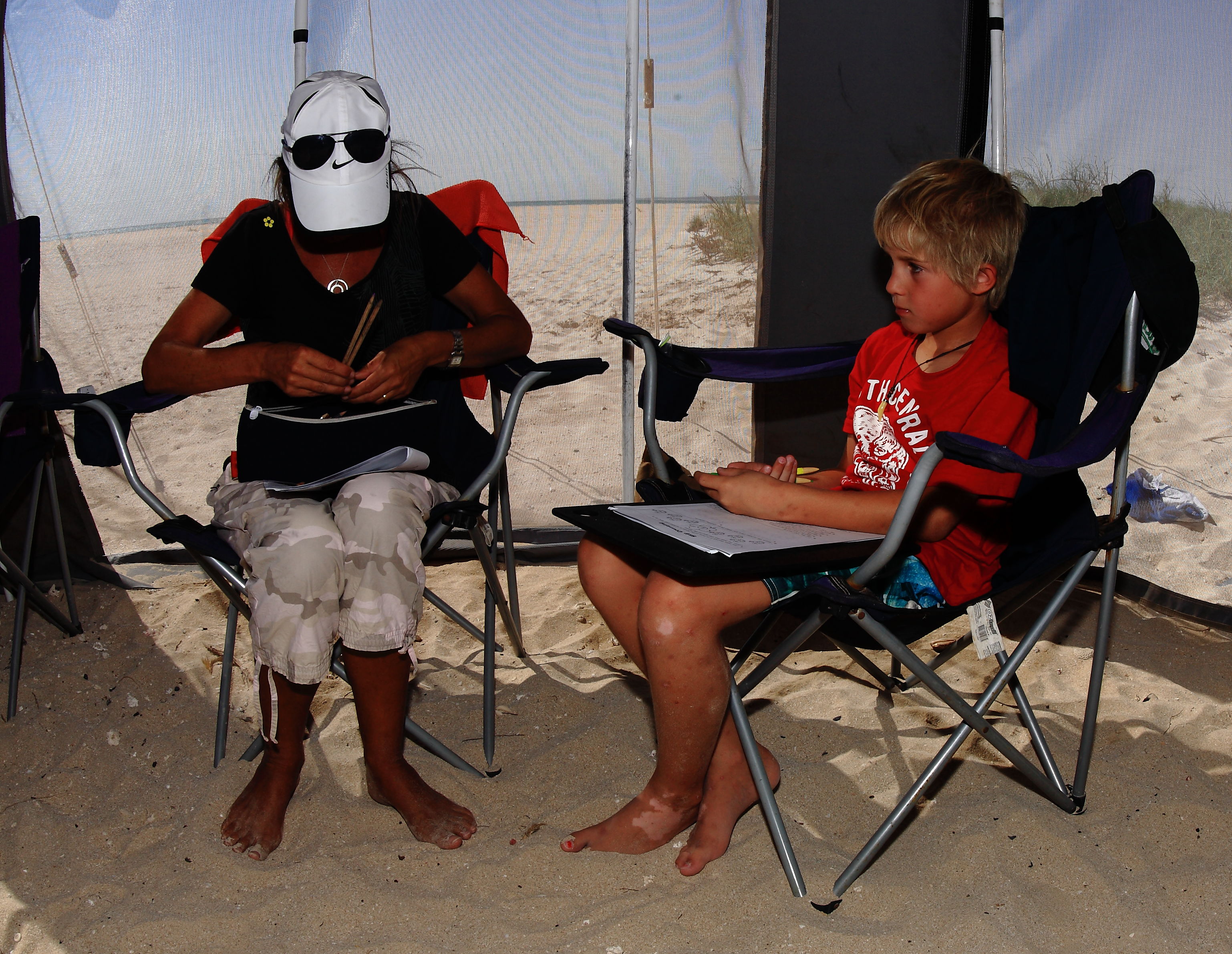
Schooling on the road

Seven months in and we haven’t mentioned the kids schooling yet!

Before leaving Sydney we met the kids teachers and they provided us with learning materials, pencils and bags. It was good for the kids to meet them in person at the start so they who they were working with.

Ningaloo classroom

Ningaloo classroom

Sydney Distance Education Programme (SDEP) provide all the work packs and reading books in fortnightly folders and send these to us to pre-agreed post office addresses. Whenever we can we arrange to phone the teachers, though given the lack of Telstra coverage in the outback it tends to be sporadic, or an opportune call from the teachers catches us in the car with a single bar reception making communication patchy.


Oscars Percussion set

Oscars Percussion set

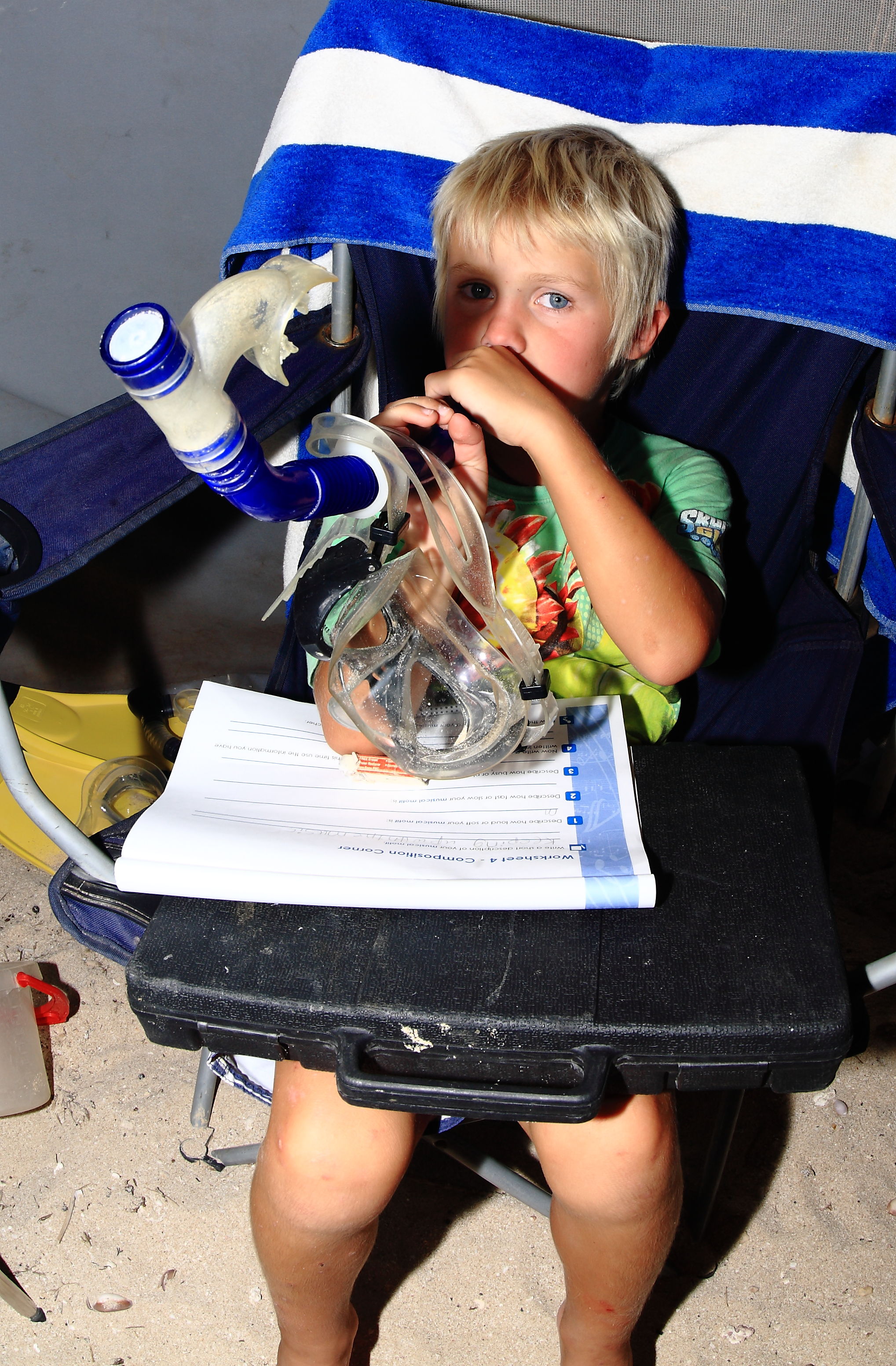
OplaysSnorkel

Playing an improvised snorkel trumpet


We then have to ensure the work gets done which can be quite a challenge when other kids are running around the campsite playing, or a new exciting beach, river, or forest beckons beyond the canvas awning. The best time of day for them to focus is after breakfast rather than tired in the afternoon, but often we find ourselves de-camping at this time so it is very hard to get a consistent routine going.

Our best results, which are few and far between, are where we have a big camp kitchen table that we can occupy and spend a couple of days catching up (or getting ahead). Every two weeks we have to find a town post office to send everything back.

In between, where we can, we send photos or voice recordings to keep up the communication with SDEP and they are very accommodating and flexible letting families do what works best for them. They have been providing reading books on a regular basis and sending the kid’s favourite authors on request.

We’ve had a couple of mad scrambles to make post offices before they close, twice entering less than 5 minutes before closing, after hours of driving. On both occasions it was in a town where we had no intention to stop so missing the post office could have really put a spanner in the works. One of those times required banging on the closed door when we discovered we were one package short, missed by the lady, who based on her demeanour clearly wanted to go home.

Another self-imposed challenge we have is data! We underestimated the amount of data required on our mobile plan, especially when skyping. Twice we have used Skype early in the month and ran out, which then restricts how much we can email back to the school (not to mention silence on the blog publication!).

That said we are very happy with SDEP and their flexibility, and we fully appreciate how hard a teachers job can be. We have even considered swapping supervisor roles with other families we have met using SDEP, as kids don’t listen to their own parents as much as other peoples.

Any tips from readers would be much appreciated!!

Categories: Adventure, Big Lap, Camper Trailer, Discover Australia, Explore Australia, Journey Narrative, Kids Travel, School, Travel, Travel Adventure | Tags: , , | 5 Comments

Ningaloo Station

Ningaloo Station is a homestead to the south of Cape Range. Historically, four-wheel drive enthusiasts have used the crossing at Yardie Creek to make the trip from Coral Bay to Cape Range considerably shorter than having to go via Exmouth. Unfortunately for us the recent cyclones meant Yardie Creek was several metres deep and there had been a recent incident where someone had tried to cross the sandbar and ended up with his car written off. It was stuck for two days before it was retrieved. We took the main road, taking a brief diversion into the eastern side of Cape Range to visit the Charles Knife gorges, the main one, ShotHole Canyon was still closed from the recent cyclone. As well as commanding fabulous views across the peninsula, there are a number of well sites throughout the North West Cape where oil exploration had taken place in the mid 1950s. After drilling almost 4700m and not finding commercial hydrocarbons the wells were plugged.


On recommendations from WA locals, Brett and Doreen, and Gary and Pam, we had set our minds on visiting South LeFroy campsite on Ningaloo. The road in to the homestead was very corrugated and after an hour we arrived at a very dilapidated looking house surrounded by a huge flock of sheep and a handful of goats. Most of the coastal stations are for pastoral grazing and their 99 year leases will expire in June. The government is trying to reclaim the 2km coastal strip seeing potential to protect and/or develop the resource and regulars are concerned that their paradise will be lost forever, or will become too expensive. Currently dog-friendly, but lacking toilet and rubbish facilities, chemical toilets are required and rubbish needs to be taken with you when you leave.

A National Park style development would be ideal, however, the prospect of developing expensive eco-resorts would surely not bode well for the pristine coral reefs that lie metres from the beach in the crystal clear waters. We’ll watch this closely to see what happens.

A week at Ningaloo was not enough. We spent hours beachcombing or swimming over the reef. Reef sharks, turtles, abundant corals, and fish life proliferate. A short drive from the campsite took us over the sandhills, past the water bores to Norwegian Bay, the derelict site of an old whaling station. The rusting hulks of boilers and machinery littered the land behind the beach and made for some interesting exploration. The remnants of the old jetty and more machinery sit peacefully on the beach, now a marine reserve, and a solitary dolphin was hunting in the shallows 50m further along the beach.

A short diversion off the same road takes you to a popular fishing spot called Shark Alley. We visited several times, and couldn’t resist a snorkel. This was probably the clearest water but a strong current meant the kids had to be careful not to stray too far from the shore. Surprisingly though no sharks were spotted but more turtles and plenty of fish. Oscar’s new favourite fish was the giant unicornfish that really does have a unicorn protruding from the top of its head. We fished there and caught some of the most beautiful coloured wrasse and trigger fish. Nothing for dinner that day though.

On our last day Oscar and I were taken out fishing in the lagoon. One monster nearly pulled Oscar off the boat as he tried to reel it in, with me holding onto him, before it shook the hook. On the last cast of the day, with the sun having just set, I managed to land a legal sized spangled emperor, so no sausages for dinner!


Categories: Adventure, australia, Australian Outback, Beach, Big Lap, Camper Trailer, Discover Australia, Explore Australia, Journey Narrative, Kids Travel, National Park, Natural World, Offroad, Photography, Photos, Travel, Travel Adventure, West Australia | Tags: , , , , , | 2 Comments

Waroora Station

The drive between locations has started to increase and the drive to Waroora Station included a brief pit stop in Carnarvon for restocking of fuel and food. We had a brief lunch by the water next to a kid’s park with an impressive flying fox. Some energy expended in the park means less to vent in the car (in theory anyway).

When we finally found the Waroora station turn-off it was corrugations for the next 45 minutes or so. Interestingly, Google and Apple maps did not agree on the directions, as Amanda and I didn’t, and some time later we arrived at the wrong campsite! We had heard wonderful things about Maggies but ambiguous signposts lead us to 14 Mile beach. On the way we admired a vista of giant red termite mounds, rising up to 3m skywards scattered across the pastoral landscape.

The grey nomads appeared to be well established there, with all their neatly lined up caravans facing the ocean, many with boats. Flags were hoisted, TV aerials in place, and many seemed to be set for long stays. The camp host directed us down to the “blow in” campsite, ostracised from the main sites, beyond the car turning point. It was exactly what we wanted, away from the rest, with only beach beyond us and metres from the lapping ocean.

It was our chance to try out our own chemical toilet, researched prior on the internet, as you are required to have one, or rent one from the homestead. We were all pleasantly surprised at its success, and with a dump point nearby it passed with flying colours.

The water here was beautifully warm and for the first time the Ningaloo Reef was tempting us, just out of swimming range, maybe half a kilometre out. The intention was an overnight stay but after an early morning walk down the beach revealed a small reef closer to the beach we decide to stay and try it out.

It’s worth mentioning at this point that the flies were at their most revolting here. This is where the flies were so thick we had to eat dinner in the car to control their numbers as we hadn’t bothered using an awning!

The reef was fun, quite small with a bit of a current but we all saw turtles, plenty of fish life and first glimpses of coral. The kids scoured the beaches looking for shells, and built houses in the sand dunes as the sun went down. The sunsets were marvellous, though we still haven’t witnessed a green flash sunset yet.

Interestingly, in July the 99 year leases on the land expire and for the first time the Department of Environment will not be renewing the coastal land. It looks like it will go under National Park management, resulting hopefully in better waste management and proper toilet facilities, rather than the makeshift open site provided by the homestead.


Categories: 4WD, Adventure, australia, Australian Outback, Beach, Big Lap, Camper Trailer, Discover Australia, Explore Australia, Journey Narrative, Kids Travel, Mitsubishi, Natural World, Offroad, Photography, Photos, Travel, Travel Adventure, West Australia | Tags: , , , | 2 Comments

Create a free website or blog at WordPress.com.